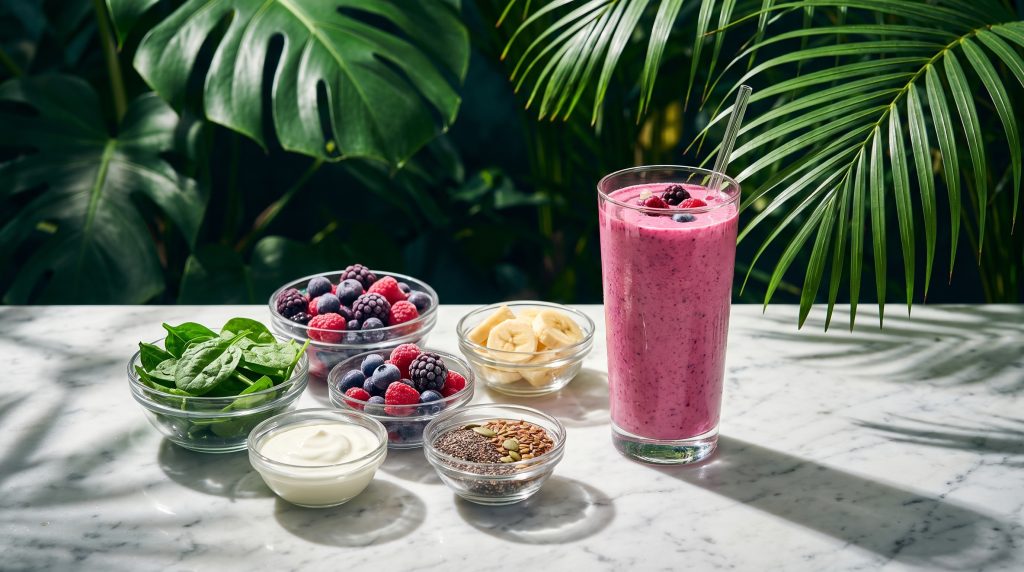
The healthiest smoothie formula (5 steps)
There is no single healthiest smoothie — what works brilliantly for one person might not suit another. But there is a formula that almost always produces something nutritious, satisfying, and genuinely enjoyable to drink. It has five components, and once you know them, you can build a great smoothie without following a recipe ever again.
Here is the formula. Follow all five steps and the result will be: filling enough to count as a meal or substantial snack, balanced in sugar and protein, genuinely nutrient-dense, and — importantly — actually pleasant to drink.
Step 1: choose a good liquid base
The liquid you use forms the backbone of the whole drink, so it is worth choosing thoughtfully.
Best options:
- Water — calorie-free, neutral, lets the fruit flavours come through cleanly. Use it when you want a lighter, less creamy result.
- Oat milk — adds a mild, slightly sweet flavour and a small amount of extra fibre. Works beautifully with banana, strawberry, and berry smoothies.
- Unsweetened almond milk — very light, low in calories, neutral in flavour. Good if you want creaminess without much additional sweetness.
- Coconut milk (carton, not tin) — slightly richer, adds a tropical note. Excellent with mango, pineapple, or cherry.
- Dairy milk — adds protein naturally. Fine if you are not avoiding dairy.
What to avoid as a primary base:
Fruit juice. It seems like a natural choice — it is sweet, it is fruity — but using juice as a base compounds the sugar content of the smoothie considerably without adding any fibre. You end up with a drink that is significantly more sugary than necessary, and it does not keep you full nearly as long. A small splash of juice for flavour is different; a full 200ml as a base is a different story.
How much liquid: Start with 150–200ml and adjust after blending. You can always add more; you cannot take it away once the blender is running.
Step 2: add your whole fruit
Whole fruit — not juice, not concentrate, not flavoured syrup — is the foundation of a healthy smoothie. Frozen fruit works just as well as fresh, and in some cases better. Fruit that is frozen shortly after harvest can actually retain more nutrients than fresh fruit that has spent several days in transit and storage before reaching your kitchen.
Lower-sugar fruit options (good for those watching sugar intake):
- Blueberries
- Raspberries
- Strawberries
- Blackberries
- Kiwi
Higher-sugar fruit options (delicious, still nutritious, just worth knowing):
- Banana (also adds natural creaminess)
- Mango
- Pineapple
- Cherries
A sensible portion is around 100–150g of fruit per serving. That gives you genuine fruit flavour and nutrition without tipping the smoothie into dessert territory.
The key reason whole fruit matters is fibre. When you blend whole fruit, the fibre stays in the glass. Fibre slows the rate at which natural sugars are absorbed into your bloodstream, which means the sugar in a fruit smoothie behaves quite differently to the same amount of sugar consumed without fibre. This is covered in more depth in our post on whether smoothies are healthy, but the short version is: fibre is your friend, and blending preserves it.
Step 3: add some vegetables
Before you click away — hear us out. Adding a large handful of spinach to a smoothie made with berries or mango does not taste of spinach. Genuinely. The fruit overwhelms it completely. What you end up with is a smoothie that looks darker or greener, but tastes almost identical to one without any greens.
The nutritional benefit, however, is real. Spinach is a source of iron, folate, calcium, and vitamin K. A handful in a smoothie is a straightforward way to boost your micronutrient intake without any particular effort or suffering.
Vegetables that work well in smoothies:
- Spinach — the classic. Mild flavour, blends smoothly, virtually invisible in a berry or mango smoothie.
- Kale — stronger flavour, works best with bolder fruit combinations. Remove the tough stalks first.
- Courgette — sounds unusual, but frozen courgette chunks blend into a pale-coloured, creamy base. Almost completely flavourless. Excellent for adding bulk and fibre without changing the taste.
- Cucumber — adds lightness and hydration. Good in green-leaning smoothies.
- Carrot — sweeter than you might expect. Works well with mango, ginger, and orange.
- Frozen cauliflower — another surprisingly good base ingredient. Adds creaminess and bulk with almost no flavour.
What not to add: Anything you would never want to taste in a drink. Raw beetroot, for example, has a very strong flavour and will dominate everything. If you want beetroot in a smoothie, start with a tiny amount and build up from there.
Step 4: add protein
A fruit-and-vegetable smoothie is primarily carbohydrate. That means it provides quick energy, which is fine, but it also means it may not keep you full for very long. Adding a source of protein addresses this.
Protein slows digestion and increases satiety — meaning you will stay full for longer after a protein-containing smoothie than after a pure fruit one. If you are having a smoothie as a meal replacement or a post-workout recovery drink, protein is particularly important.
Good protein additions:
- Protein powder — typically adds 20–25g of protein per scoop. Vanilla, chocolate, or unflavoured versions all work. Choose one with a short, recognisable ingredients list. Pea protein and hemp protein are good vegan options. We have a whole post on protein smoothies if you want to go deeper.
- Nut butter — a tablespoon of peanut butter, almond butter, or cashew butter adds around 4–5g of protein, plus healthy fats that further slow digestion. Also makes the smoothie considerably creamier.
- Hemp seeds — 3 tablespoons contains around 10g of protein. Flavour is mild and slightly nutty. Blends well.
- Chia seeds — slightly lower in protein (around 5g per 3 tbsp) but rich in omega-3 fatty acids and fibre.
- Greek-style coconut yoghurt — adds protein and a pleasant tang, especially good in mango or berry smoothies.
Step 5: add a booster
This is the optional step that takes a good smoothie and makes it something you actively look forward to. A booster can mean many things — a flavour element, a nutritional addition, or both.
Popular booster options:
- Matcha — ceremonial-grade Japanese matcha adds a vivid green colour, a gentle caffeine boost, and a pleasant earthy flavour. It contains L-theanine, which softens the caffeine effect so you get focus without jitters. About half a teaspoon per serving is plenty.
- Flaxseed (ground) — excellent source of omega-3 fatty acids and additional fibre. Ground flaxseed blends smoothly and almost invisibly. One tablespoon is a reasonable amount.
- Turmeric — best paired with a pinch of black pepper (which improves absorption of curcumin, turmeric’s active compound). Adds warmth and a golden colour. Works well in mango or carrot-based smoothies.
- Ginger — fresh or frozen. A small thumb-sized piece adds brightness and a pleasant heat, particularly good with mango or pineapple.
- Cinnamon — adds warmth and subtle sweetness without adding sugar. Works especially well in banana or apple smoothies.
- Cacao powder — the raw, less-processed version of cocoa. Rich in flavonoids, adds a deep chocolate note, and works brilliantly with banana or cherry.
Putting it all together: a practical example
Using the five steps:
- Base: 200ml oat milk
- Fruit: 100g frozen blueberries, half a frozen banana
- Veg: large handful of spinach
- Protein: 1 tablespoon peanut butter
- Booster: 1 tablespoon ground flaxseed
Blend everything until smooth. The result is a purple-hued smoothie that contains genuine nutrition across multiple food groups — and, critically, tastes of blueberry and banana rather than anything resembling a health supplement.
The sugar balance: which fruit to choose
There is no reason to avoid high-sugar fruit — banana and mango are genuinely nutritious and delicious. But if you are specifically trying to keep the sugar content lower, berries are your best option. Blueberries, raspberries, and strawberries all have considerably lower natural sugar content than banana or mango, while still providing plenty of flavour, antioxidants, and fibre. For a deeper look at blueberries specifically, see our blueberry smoothie post.
What Framberry puts in its smoothies
At Framberry, we follow this same logic: real whole fruit (fresh and frozen), plant milk as a standard base, and build-your-own protein and superfood booster options. We do not use juice concentrates, added syrups, or hidden sweeteners. The goal is a smoothie you can feel good about — and actually enjoy drinking.
Have a look at our full range on the smoothies menu. We are opening in London in 2027, and you can join the list to hear about it first.
Frequently asked questions
Q: What is the single healthiest ingredient to add to a smoothie?
A: If forced to choose one, leafy greens like spinach would be a strong candidate — they add micronutrients (iron, folate, calcium) at almost no caloric cost, and they are genuinely invisible in flavour when blended with fruit. Ground flaxseed is a close second for the omega-3 and fibre content.
Q: Is frozen fruit as healthy as fresh?
A: Yes, and sometimes more so. Fruit frozen quickly after harvest can retain more vitamins than fresh fruit that has spent several days in transit and storage. For smoothies, frozen fruit is often the better practical choice because it keeps longer, reduces food waste, and gives a colder, creamier texture without ice.
Q: Do I need protein in every smoothie?
A: No, but it helps with satiety. If you are having a smoothie as a light snack alongside other food, a pure fruit smoothie is perfectly fine. If you are having it as a meal or after exercise, adding protein makes a meaningful difference to how long it keeps you full.
Q: Can I add too many ingredients to a smoothie?
A: Practically, yes — too many ingredients can result in a muddy flavour where nothing quite comes through. The five-step formula works partly because it keeps each category purposeful. Three to five total ingredients tend to produce better results than eight.
Q: Is it better to make smoothies at home or buy them?
A: Both can be good, and the quality difference comes down to ingredients rather than location. A freshly made smoothie at a quality bar using real whole fruit is equivalent to homemade. A shelf-stable bottled smoothie with concentrates and added sugars is a different category entirely.
Want to try a smoothie built on this formula without the washing up? Our smoothie menu covers the classics and the build-your-own options. Framberry opens in London in 2027 — join the list to be among the first through the door.