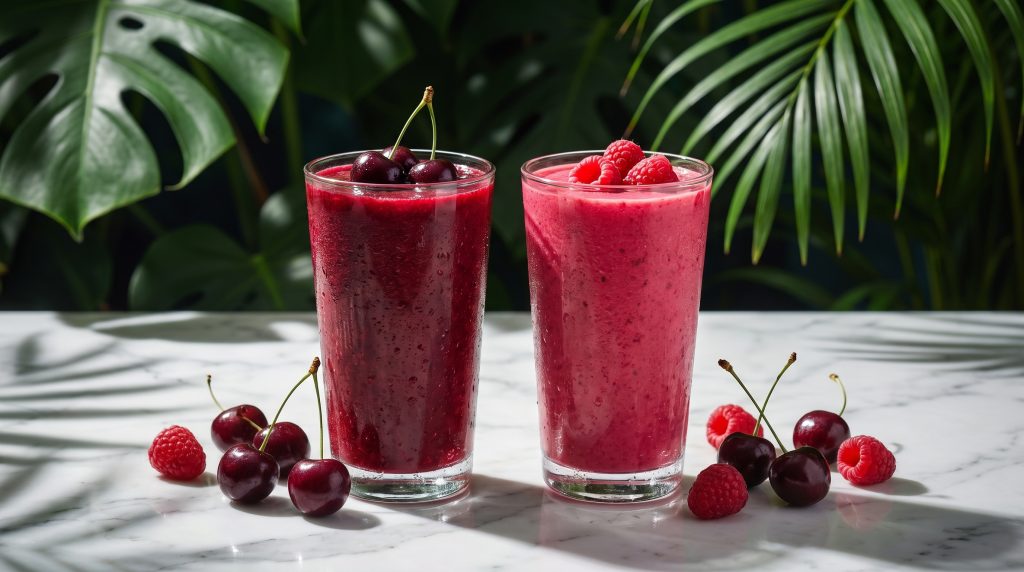
Cherry smoothies are deep, rich and slightly earthy — the frozen fruit is key for both flavour and that remarkable dark-red colour. Raspberry smoothies are brighter and sharper, with a tartness that makes them feel fresher. Both take five minutes. Here are the recipes, a few variations, and what each fruit actually brings to the glass.
The cherry smoothie recipe
Frozen pitted cherries are the backbone here. Fresh cherries work, but the faff of pitting them makes frozen the obvious choice for a morning smoothie — and frozen cherries tend to have an intense, concentrated flavour that works better in a blender.
Recipe card — Cherry smoothie
– Prep: 5 min / Serves: 1
– Ingredients:
– 150g (1 cup) frozen pitted cherries
– 1 small banana
– 200ml (¾ cup) oat milk
– ½ tsp vanilla extract
– Steps:
1. Add cherries and banana to blender.
2. Pour in oat milk and vanilla extract.
3. Blend on high for approximately 45 seconds until smooth.
4. Serve immediately — the colour is a deep, dark red that fades quickly, so don’t leave it sitting.
– Nutrition (approx): ~200 kcal, 40g carbs (of which ~32g natural sugars), 4g protein, 4g fibre
The raspberry smoothie recipe
Raspberries are the most fibre-rich of the common smoothie fruits — roughly 7g per 100g — and they have a bright, clean tartness that stands out without needing the sweetness of a lot of banana or added sugar. Coconut yoghurt is optional but adds a welcome creaminess.
Recipe card — Raspberry smoothie
– Prep: 5 min / Serves: 1
– Ingredients:
– 150g (1 cup) frozen raspberries
– 1 medium banana
– 150ml (⅔ cup) oat milk
– 1 tbsp honey or agave (optional — taste first, the raspberries may be sweet enough)
– 1 tbsp coconut yoghurt (optional — adds creaminess)
– Steps:
1. Add raspberries, banana and oat milk to blender.
2. Add honey or agave and coconut yoghurt if using.
3. Blend on high until smooth — about 45 seconds.
4. Taste. Raspberries vary in sweetness between batches; adjust sweetness accordingly.
5. Add a handful of ice and blend briefly if you want a thicker, colder result.
– Nutrition (approx): ~190 kcal, 38g carbs (of which ~28g natural sugars), 4g protein, 8g fibre (higher with coconut yoghurt: ~220 kcal)
Why frozen fruit works best here
For both of these smoothies, frozen fruit is the clear recommendation. The reasons are consistent with most fruit-forward smoothies:
Texture: Frozen fruit thickens the smoothie naturally, without ice diluting the flavour.
Flavour: Cherries and raspberries are frozen at peak ripeness. The frozen bag in January is typically better than the fresh punnet sitting on a supermarket shelf for several days.
Convenience: Frozen raspberries and cherries are available year-round, relatively affordable, and require no preparation beyond measuring.
The one thing frozen fruit can’t give you is the visual appeal of a whole fresh berry on top of the drink. If presentation matters — for a smoothie bowl, say — use frozen for blending and fresh for garnish.
Variations
Cherry and chocolate smoothie
Add one tablespoon of cocoa powder to the cherry recipe. Blend as normal. The result is a flavour that tastes more like a Black Forest dessert than a fruit drink — which is either a selling point or a concern, depending on the occasion. Rich, dark, and genuinely indulgent. For a protein version, add a scoop of chocolate protein powder.
Raspberry lemonade smoothie
Add the juice of half a lemon and two teaspoons of agave to the raspberry recipe. The lemon amplifies the sharpness of the raspberries and the result is very close to the flavour of a proper raspberry lemonade — bright, sharp and refreshing. Serve over plenty of ice.
Mixed berry smoothie
Combine 75g of frozen raspberries, 75g of frozen blueberries, and a small banana. Blend with oat milk. This is the simplest variation and one of the best — the blueberries add depth and the antioxidant-rich combination makes this a strong everyday smoothie. See our blueberry smoothie recipe for more in this direction.
What do cherries and raspberries actually bring?
Cherries — particularly Montmorency cherries — have attracted research interest for their anthocyanin content, and some studies suggest they may have anti-inflammatory properties. We’d characterise the evidence as promising but preliminary; it doesn’t yet support strong claims. What we can say confidently: cherries are a source of vitamin C and potassium, and they taste excellent in a smoothie.
Raspberries are one of the most fibre-rich fruits you can blend — roughly 7g per 100g, compared to around 1.5g for a banana. They’re also a source of vitamin C and manganese. The high fibre content makes a raspberry smoothie slightly more sustaining than other fruit-forward blends.
For both fruits, the honest conclusion is: they’re good for you in the way that fruit generally is, their specific nutrient contributions are genuinely useful, and the more elaborate health claims circulating online are speculative.
Framberry’s cherry and raspberry smoothies
Cherry and raspberry are both on Framberry’s fruit menu. You can blend them together or with any other fruit on the menu — strawberry and raspberry is a classic combination; cherry and banana is rich and filling. Add a protein booster if you want to take either smoothie further.
Framberry is opening in London in 2027. Join the list to hear when we open.
Frequently asked questions
Can I use fresh cherries instead of frozen?
Yes, but you’ll need to pit them first, which takes time. If using fresh cherries, add a handful of ice cubes to the blender to compensate for the cold and thickness that frozen fruit provides.
Do I need to add sweetener to a raspberry smoothie?
It depends on the batch. Frozen raspberries vary in sweetness. Taste the smoothie before adding honey or agave — it may not need it. A ripe banana in the blend usually provides enough natural sweetness.
What’s the best milk to use in a cherry smoothie?
Oat milk is our first choice — it’s mild and slightly sweet, which suits the cherry well. Almond milk gives a cleaner, drier result. Coconut milk from a carton adds richness and a slight tropical note that’s an interesting contrast to the cherry’s earthiness.
Can I make a cherry or raspberry smoothie without banana?
Yes. The texture will be less creamy. Avocado adds creaminess without the sweetness; half an avocado in a cherry smoothie works well. Alternatively, a tablespoon of nut butter gives body and fat without adding much flavour.
Are raspberries high in sugar?
Raspberries are among the lowest-sugar fruits commonly used in smoothies — roughly 5g of natural sugar per 100g. This makes them a strong choice for lower-sugar smoothies. See our low-sugar smoothie guide for more on building lower-sugar blends.
Cherry and raspberry are both part of Framberry’s build-your-own menu — opening in London in 2027. See what’s on our smoothies menu or join the list.