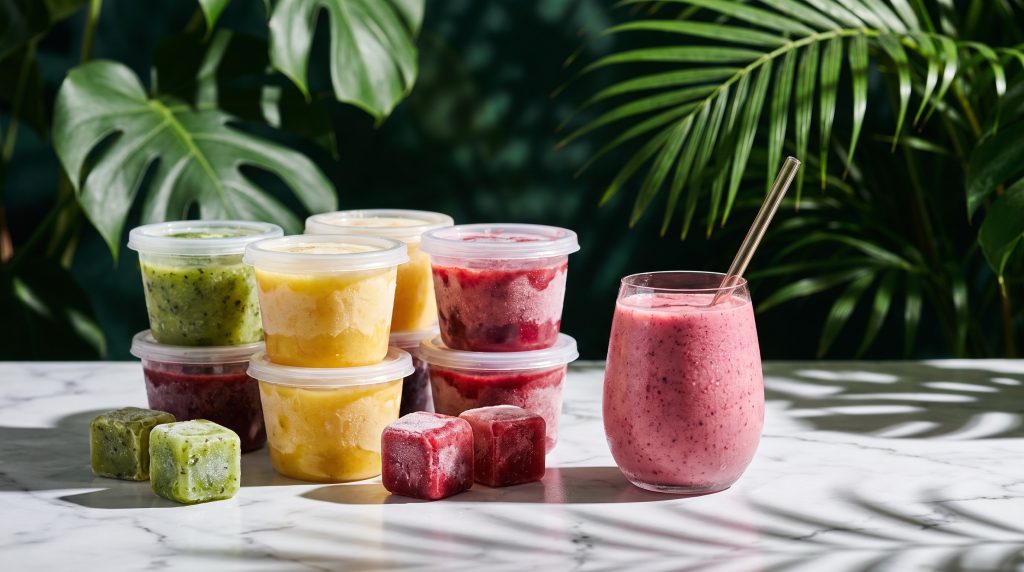
Can you freeze smoothies? Your make-ahead guide
Yes — smoothies freeze very well, and the practice is genuinely useful for anyone who wants a nutritious drink on busy mornings without blending from scratch every day. A batch-blended smoothie, properly frozen, keeps for up to three months and takes very little effort to prepare in advance.
There are a few things worth knowing about best practice for freezing, defrosting, and which ingredients to be slightly cautious about. Here is the complete guide.
Why freeze smoothies?
The case for freezing smoothies is straightforward: you do most of the work once, at the weekend or whenever you have time, and have ready-to-go portions for the rest of the week.
For people who want a good breakfast quickly, or who meal prep in general, freezing smoothies removes the daily friction of gathering ingredients, measuring, blending, and washing the blender. It is also useful for reducing food waste — if you have very ripe fruit that needs using, blending it into smoothie portions and freezing preserves it immediately.
Step 1: make your smoothie as normal
Blend your smoothie to your usual consistency. If you are making a batch specifically for freezing, you might want to blend it slightly thicker than your normal drinking consistency — it will thin slightly upon thawing.
Good smoothies to freeze:
– Berry-based smoothies (strawberry, raspberry, blueberry, blackberry)
– Mango and banana combinations
– Tropical blends (mango, pineapple, coconut milk)
– Any smoothie made predominantly with frozen fruit
Smoothies that freeze slightly less perfectly:
– Anything containing a large amount of dairy yoghurt (can go grainy or watery when thawed — coconut yoghurt holds up better)
– Smoothies with significant leafy greens: spinach freezes acceptably but can develop a slightly different texture after a month; kale degrades more noticeably in texture after freezing
This does not mean you cannot freeze these — it means the thawed result may be slightly different from the fresh version. Give it a good shake or blend after thawing and it will usually come together perfectly well.
Step 2: choose your containers
The container you use makes a difference for both practical and quality reasons.
Mason jars (glass, with lids)
The classic choice. Glass is non-reactive, meaning it does not absorb odours or flavours over time. Crucially: leave at least 2–3cm of headspace at the top, because smoothie will expand as it freezes. A jar filled to the brim will crack. Wide-mouthed jars are easier to fill and pour from.
Silicone zip-lock bags (freezer-grade)
Excellent for space efficiency. Freeze flat, then stand upright or stack once solid. Label with the blend date and contents. Remove as much air as possible before sealing.
Reusable plastic freezer containers
Work well and are lightweight, though some plastics can absorb flavours from strongly coloured smoothies (particularly blueberry) over time. Not ideal for very long-term freezing.
Ice cube trays
Useful for freezing smoothie in smaller portions — great for adding a cube or two to a blender alongside fresh ingredients, or for portion-controlling additions. Silicone trays make removal much easier.
Step 3: freeze
Place your filled, lidded containers in the freezer. Lay silicone bags flat on a baking tray first so they freeze in a neat, stackable shape.
How long do frozen smoothies keep?
– Up to 3 months for best quality and flavour
– Still safe to consume beyond that, but flavour and colour may begin to degrade
– Label your containers with the blend date — it is very easy to forget
Step 4: defrost and serve
Method 1: Overnight in the fridge (best results)
Transfer your frozen smoothie from the freezer to the fridge the night before. By morning, it will be thawed and cold, ready to shake and drink. This is the gentlest method and produces the best texture.
Method 2: Water bath (30–60 minutes)
Place the sealed container in a bowl of cold or lukewarm water. This speeds thawing considerably. Do not use very hot water — rapid temperature change can crack glass jars and can also start to affect the smoothie’s flavour.
Method 3: Room temperature (45–90 minutes)
Leave the container on your kitchen counter. This works fine but takes longer than a water bath.
Method 4: Blend from frozen
Empty the frozen smoothie (or scoop it out if solid) directly back into your blender with a splash of liquid and re-blend. This is effectively the same as making a fresh smoothie from frozen ingredients — the result is excellent because the blending process brings everything back together properly.
Once thawed, a smoothie keeps for up to 24 hours in the fridge. Do not refreeze a thawed smoothie.
Handling separation — it is normal
A thawed smoothie will very likely have separated — you will see liquid sitting above or below denser solids. This is entirely normal and does not mean the smoothie has spoiled. Simply shake the jar vigorously or stir with a long spoon until recombined. If you have re-blended from frozen, separation is not an issue.
Step 5: batch prep tips for the week
The real power of smoothie freezing is in batch preparation. Here is a practical Sunday routine:
- Make four to five portions of your chosen smoothie in one blending session
- Pour into individual mason jars or silicone bags, leaving headspace
- Label each with the date and flavour
- Freeze all at once
- Take one out each evening and place in the fridge — it is ready to shake and drink the following morning
If you prefer more variety, make two or three different flavours — a berry, a mango, and a banana combination — and freeze portions of each. You now have a week’s worth of smoothies with minimal daily effort. Our banana smoothie is an excellent batch-prep candidate — ripe frozen banana blends brilliantly, and the result freezes very well.
Ingredients that freeze brilliantly
- Frozen fruit (this is why frozen smoothie packs exist)
- Fresh fruit that has been blended (especially banana, mango, berries)
- Nut butters (do not separate; add body and richness after thawing)
- Protein powder (blends back in perfectly)
- Seeds — chia, flax, hemp (unaffected by freezing)
- Oat milk, almond milk, coconut milk (freeze fine; may need a shake)
- Matcha (no degradation noted for up to three months)
Ingredients to be aware of
- Dairy yoghurt — can separate and become grainy on thawing; coconut yoghurt is more stable
- Fresh leafy greens — spinach is fine for the first month or so; after that, the texture begins to degrade. Kale is less forgiving. If you are planning to freeze long-term, consider leaving the greens out and adding them fresh when you re-blend.
- Banana — freezes brilliantly and thaws well; just be aware that over-thawed banana (left too long at room temperature) goes very mushy before you drink it
Frequently asked questions
Q: Can you freeze smoothies made with protein powder?
A: Yes, protein powder smoothies freeze perfectly. The protein does not degrade significantly with freezing. Shake or re-blend after thawing to reincorporate.
Q: How do I stop my mason jar cracking in the freezer?
A: Always leave at least 2–3cm of headspace to allow for expansion. Use wide-mouthed jars if possible, as they handle freezing better. Do not put a warm smoothie directly into the freezer in a glass jar — allow it to cool to room temperature first.
Q: Can I freeze a smoothie and drink it like a slushy?
A: Yes — let it thaw for 15–20 minutes and drink while still partially frozen for a slushy consistency. Works particularly well with berry or tropical smoothies.
Q: Do frozen smoothies lose nutrients?
A: Some minor degradation of heat-sensitive vitamins (particularly vitamin C) can occur over very long freezer storage, but the loss is modest — particularly compared to the nutrient loss that occurs in fresh produce sitting in storage or transit. Frozen smoothies consumed within three months are nutritionally very close to their fresh-blended equivalents.
Q: Can I freeze smoothies in plastic bags?
A: Yes, provided they are freezer-grade bags rated for low-temperature storage. Thin sandwich bags are not suitable — they become brittle and may split.
HowTo schema data
How-to name: How to freeze smoothies
Description: A step-by-step guide to freezing, defrosting, and batch-prepping smoothies for the week ahead.
Total time: 15 minutes prep (plus freezing time)
Tools: Blender, mason jars or silicone freezer bags, freezer
Steps:
1. Blend your smoothie to a slightly thicker consistency than usual.
2. Pour into mason jars or silicone freezer bags, leaving 2–3cm headspace for expansion.
3. Label each container with the blend date and contents.
4. Freeze immediately; smoothies keep for up to 3 months at best quality.
5. Defrost overnight in the fridge, in a water bath, or re-blend directly from frozen.
6. Shake or stir vigorously after thawing to recombine any separation.
7. Consume within 24 hours of thawing; do not refreeze.
If batch prep is not your thing, we have you covered at the bar. Take a look at our smoothies menu and see what we blend fresh every day. Framberry opens in London in 2027 — join the list to find out when we land near you.