Medical disclaimer: This post is for general information only and does not constitute medical advice. Always consult your GP, health visitor, or paediatric dietitian for guidance specific to your child’s age, health, and dietary needs.
Are babychinos caffeine-free and safe for toddlers?
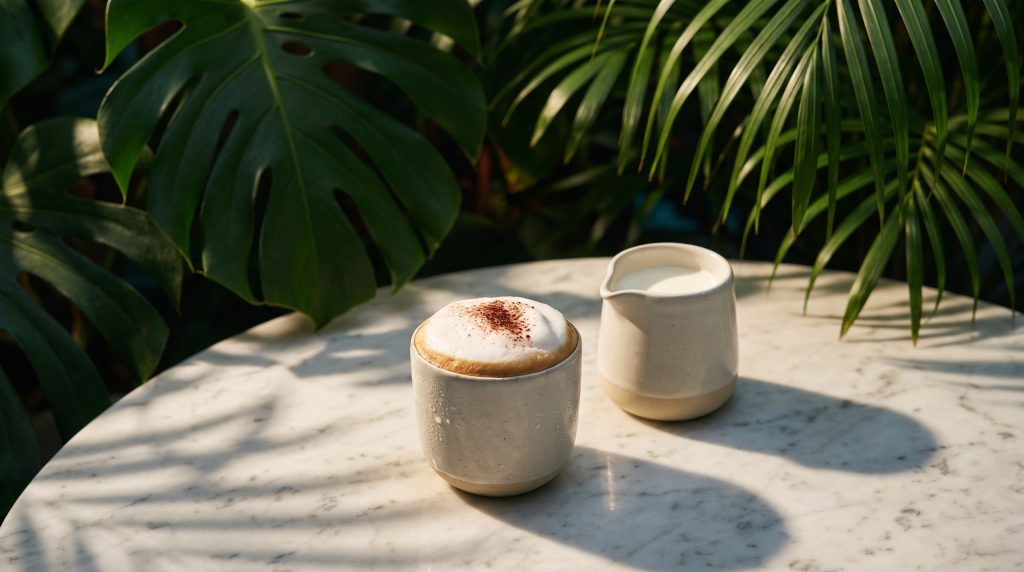
Yes — a babychino is completely caffeine-free. It is warm frothed milk and nothing else, with an optional pinch of cocoa powder or a mini marshmallow on top. There is no coffee, no tea, no espresso, and no caffeine of any kind in the drink itself.
That said, there are a few things worth knowing if you are a parent deciding whether to order one for your child — particularly around age, milk alternatives, and temperature. Here is a clear, no-fuss guide.
Does a babychino contain caffeine?
No. A babychino contains zero caffeine. It is warm frothed milk, served in a small cup. The name is borrowed from “cappuccino,” but a babychino contains no coffee and no espresso — the drink is designed specifically to give children the café experience without any of the ingredients that make adult coffee drinks unsuitable for them.
The NHS advises that caffeine is not recommended for children, particularly those under 12. Babychinos were created precisely to offer an alternative: something warm, frothy, and café-feeling that contains nothing a child should not have.
The small dusting of cocoa powder that some cafés add to the top is a garnish only — a pinch so small that it contributes a negligible amount of theobromine (the stimulant found in cocoa), and no caffeine to speak of. If you prefer to leave the cocoa off entirely, most cafés — including Framberry — will happily oblige.
Is warm milk safe for toddlers?
Yes. Warm milk is entirely appropriate for toddlers and has been a staple of childhood nutrition for as long as people have kept cows. There is nothing about warming milk that makes it unsafe; in fact, many children find warm milk soothing, which is part of the appeal of the babychino in the first place.
The important safety point is temperature: milk for young children should be served lukewarm, not hot. Young children’s mouths and throats are more sensitive to heat than adults’, and they may not communicate clearly if something is uncomfortably warm. A babychino should feel pleasantly warm to the touch on the outside of the cup — not scalding. If you are making one at home, the inside-of-wrist test is a reliable guide: if it feels comfortable there, it is safe to serve.
At Framberry, we serve babychinos lukewarm as standard.
What age is a babychino suitable for?
A babychino is warm frothed milk, so the relevant guidance is around milk rather than the drink itself.
- Infants under 6 months: Breast milk or formula only. No cow’s milk or alternatives.
- 6–12 months: Cow’s milk can be used in cooking and mixed into foods, but breast milk or formula should remain the primary drink.
- 12 months and over: Whole cow’s milk can be introduced as a main drink. From this age, a babychino is appropriate.
- 1–2 years: Whole milk (full-fat) is recommended by the NHS for this age group for its fat and calorie content. Semi-skimmed can be introduced from age 2 if the child is eating well and growing normally.
Dairy-free alternatives — oat milk, coconut milk — are suitable for children over one year as part of a varied diet. They are not nutritionally equivalent to cow’s milk or formula, so should not replace these for very young children who depend on them as a primary source of nutrition.
If you have any specific questions about what is appropriate for your child, your health visitor is the best starting point.
What about the cocoa powder? Is that safe?
The cocoa powder on a babychino is a decorative dusting — we are talking about a literal pinch. The amount of theobromine (a stimulant related to caffeine, found in cocoa) in such a small quantity is negligible. For comparison, a small piece of dark chocolate contains vastly more.
That said, if you would prefer no cocoa at all — because your child is very young, because you are avoiding any trace of stimulants, or simply because they do not like it — just ask for it without. At Framberry, a plain babychino with no topping is a perfectly reasonable and entirely normal order.
Does a babychino contain sugar?
Milk contains lactose, which is a naturally occurring sugar. This is not added sugar and is different in character from refined sucrose. A babychino made with plain frothed whole milk contains no added sugar.
If you add a mini marshmallow on top, that does introduce a small amount of sugar — marshmallows are made with sugar and corn syrup. If you would rather keep the babychino sugar-free, simply leave the marshmallow off. The cocoa powder, if present, adds a negligible amount.
Avoid any café that adds flavoured syrups to a babychino — this would introduce significant added sugar, and is not part of how the drink is traditionally made.
Dairy-free babychinos: are milk alternatives safe for children?
This is worth clarifying because different milk alternatives have different nutritional profiles:
Oat milk: Suitable for children over one year as part of a varied diet. Lower in protein and fat than cow’s milk. Not suitable as the sole or primary drink for infants or toddlers who rely on milk for most of their nutrition, but fine as one component of a varied diet for older toddlers and children.
Coconut milk (carton, as a drink — not tinned): Lower in protein than cow’s milk. Fine for occasional use; not ideal as a primary milk source for young children.
Soya milk: Can be used from 6 months as part of a mixed diet, though the NHS notes it should not replace breast milk or formula. Suitable as a main drink from one year.
Rice milk: Not recommended for children under 5 due to naturally occurring traces of inorganic arsenic.
Nut milks (almond, cashew, etc.): Low in protein; suitable for occasional use in children without nut allergies, but not as a primary milk source.
For a babychino — a small, occasional treat rather than a nutritional staple — oat milk or coconut milk are perfectly appropriate for children over one year. If your child has allergies or specific dietary needs, check with your GP or dietitian.
Allergy considerations
Cow’s milk allergy (CMA) is one of the most common food allergies in infants and young children. If your child has a confirmed cow’s milk allergy, a dairy babychino is not appropriate; a dairy-free version made with oat milk or coconut milk is the right option.
Note that cow’s milk allergy and lactose intolerance are different conditions. Lactose intolerance (difficulty digesting lactose) is relatively uncommon in young children; cow’s milk protein allergy (an immune response) is more likely to be relevant in infants and toddlers. Your GP or allergy specialist can advise on your child’s specific situation.
At Framberry, we use separate equipment for dairy-free preparations wherever possible. Please speak to a team member about allergen requirements when you visit.
Temperature safety: the most practical point
The single most important practical consideration with a babychino is temperature. Children can burn their mouths on drinks that feel only slightly warm to an adult. Always:
- Check the outside of the cup before handing it over
- Do a wrist test if making at home
- Ask café staff to confirm the drink is served lukewarm
- Allow a minute before serving if in any doubt
A babychino should be ready to drink immediately — not something that needs cooling. That is by design.
Frequently asked questions
Q: Is a babychino completely caffeine-free?
A: Yes, completely. No coffee, no tea, no caffeine. A babychino is warm frothed milk only.
Q: Can a one-year-old have a babychino?
A: Yes, from around 12 months, cow’s whole milk can be introduced as a main drink. A small babychino is appropriate from this age. For dairy-free alternatives, oat milk is suitable as part of a varied diet from one year. Always check with your health visitor if you have specific concerns.
Q: Is the cocoa powder on a babychino safe for children?
A: In the small quantities used as a garnish, yes. If you prefer to leave it off entirely, simply ask — a plain frothed milk babychino is equally lovely.
Q: What if my child has a cow’s milk allergy?
A: Ask for a dairy-free babychino made with oat or coconut milk. Always inform staff about the allergy so they can take appropriate precautions.
Q: Should I be worried about the sugar in a marshmallow on top?
A: One mini marshmallow is a very small amount of sugar. If you would rather avoid it, just ask for the babychino without.
Framberry is opening in London in 2027. Every child who comes in gets a babychino free with any adult drink — made lukewarm, made carefully, and made for them. Join the list to hear when we open.