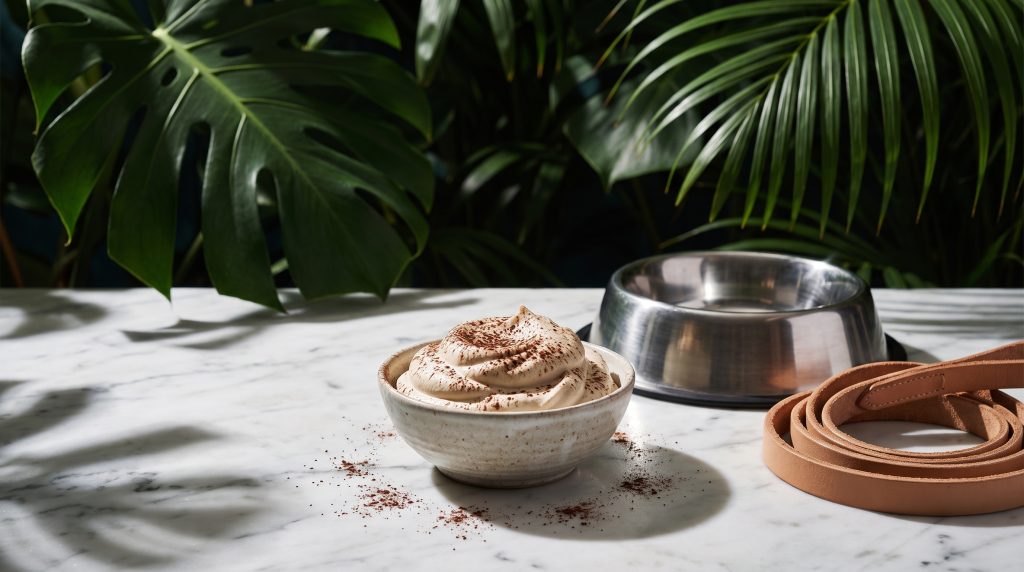
How to make a dog-safe puppychino at home (carob recipe)
A dog-safe puppychino at home takes five minutes: warm milk gently to body temperature, stir in carob powder, froth it, and let it cool to room temperature before serving. No chocolate. No cocoa. No sweeteners of any kind. Carob only.
Dogs have been accompanying humans to cafés forever. Making them their own version of a frothy café treat at home is easy, inexpensive, and significantly better for them than sharing whatever is in your cup.
Why carob and not cocoa?
This is the single most important thing to get right, so let us be direct about it:
Chocolate and cocoa are toxic to dogs. They contain theobromine, a compound that dogs cannot metabolise safely. It can cause vomiting, seizures, and in serious cases be fatal — particularly in small dogs or when consumed in quantity. There is no safe amount of chocolate or cocoa for dogs.
Carob is safe. It comes from the pod of the carob tree, has a naturally sweet, mild flavour that dogs find very appealing, and contains no theobromine and no caffeine. It has been used in dog treats for decades precisely because it is the chocolate alternative that actually works for dogs.
If a recipe for a dog treat uses cocoa powder, it is not a safe recipe. Use carob powder only.
What is carob?
Carob (Ceratonia siliqua) is a flowering tree native to the Mediterranean region. Its pods are dried and ground into carob powder — a naturally sweet, slightly earthy, mildly chocolatey ingredient used widely in human baking as a chocolate substitute and in dog treats as a safe flavouring.
Carob powder looks similar to cocoa powder and can occupy the same space in a recipe, but it has a distinct and gentler flavour — sweeter and less bitter than dark cocoa. Dogs, whose palates are not calibrated for bitterness in the way human palates are, tend to take to it readily.
Where to buy carob powder in the UK:
– Most health food shops (Holland & Barrett stock it regularly)
– Online retailers (Ocado, Amazon, specialist baking suppliers)
– Some larger supermarkets in the health food or baking aisle
Look for pure carob powder — no added ingredients, no flavourings, no sweeteners. The ingredient list should say: carob powder. That is it.
What you need
Equipment:
– Small saucepan
– Food thermometer (optional but helpful)
– Spoon or small whisk
– Milk frother (optional — a spoon works too)
– Small cup, bowl, or dog-safe dish (flat or shallow works best for dogs)
Ingredients (serves 1 — a small dog-sized portion):
– 100ml whole milk
– 1 teaspoon carob powder (NOT cocoa — carob only)
– No sweeteners of any kind
Important: No honey, no syrup, no sugar, no artificial sweeteners — particularly no xylitol, which is extremely toxic to dogs and appears in many “sugar-free” or “light” food products. Carob is naturally sweet enough that no sweetener is needed or appropriate.
Step-by-step: how to make a carob puppychino
Step 1: Warm the milk gently
Pour 100ml of whole milk into a small saucepan and warm it over the lowest heat setting. You are aiming for approximately 37–40°C — roughly body temperature. This is warmer than cold milk from the fridge but cooler than the temperature at which milk begins to steam.
If you have a food thermometer, use it. If not, the guide is: the milk should feel warm if you dip a clean finger in, but not hot. Not steaming, not simmering. Just warm.
Do not boil the milk. High heat changes the flavour and texture, and you will then need to wait a long time for it to cool before serving.
Step 2: Stir in the carob powder
Remove the milk from the heat (or keep it on the very lowest setting) and stir in one teaspoon of carob powder. Stir until fully dissolved — carob dissolves fairly easily in warm milk and should not leave lumps if you stir for 30 seconds or so.
Step 3: Froth gently (optional)
If you have an electric milk frother, run it in the milk for 15–20 seconds to create a gentle foam. This is purely for texture and aesthetics — it makes the treat feel a bit more like a proper café order. Dogs will not notice if you skip this step, but it makes for a better photograph.
If you do not have a frother, simply stir well. A whisk can create a small amount of froth if you whisk briskly for a moment.
Step 4: Pour into a dog-appropriate vessel
Use a small, flat bowl or a dog-safe dish. A flat-bottomed vessel is easier for most dogs to drink from than a tall cup. If you are going for the aesthetic — and the photo opportunity — a small cup works for the display; just transfer to something dog-appropriate before serving, or ensure the cup is wide enough for your dog’s muzzle.
Step 5: Allow to cool to room temperature
This is critical. Do not serve the puppychino while it is still warm. Dogs do not have the same ability as humans to manage heat in their mouths, and a warm drink can cause discomfort or harm.
Check the temperature by placing a few drops on your inner wrist — it should feel neutral, neither warm nor cool. Room temperature is the goal. If it feels warm at all, wait a few more minutes.
Step 6: Serve alongside water
Offer the puppychino alongside a bowl of fresh water. Dogs should always have access to water, particularly when eating treats that are richer or different from their normal food.
Safety reminder — this cannot be overstated:
No chocolate. No cocoa. No xylitol. No sweeteners. Carob only.
Double-check your carob powder tin before you start — the ingredient list should say “carob powder” and nothing else. If you are using any other product, read every ingredient on the label before adding it to a dog’s treat.
How often should you give a dog a puppychino?
Once in a while — not daily. Treats should account for no more than 10% of a dog’s daily caloric intake. A puppychino at café level frequency (one per visit, occasional visits) is fine for a healthy dog. Giving one every day would be too much of anything extra, however safe the ingredients.
For dogs with health conditions — pancreatitis, diabetes, kidney disease, food allergies — always check with your vet before introducing any new treat, including this one.
Variations
Oat milk version: Oat milk can be substituted for whole cow’s milk. Use the same quantity, warm and prepare in exactly the same way. This is suitable for dogs that are lactose intolerant. Do not use sweetened oat milk — always plain, unsweetened.
Smaller portion: For very small dogs, reduce to 50ml and half a teaspoon of carob powder. Adjust to suit the dog’s size.
Cold version: In warm weather, allow the carob milk to cool fully in the fridge before serving cold. Dogs are perfectly happy with cold treats and it can be more refreshing in summer.
Recipe card
Carob Puppychino
Prep time: 5 minutes / Total time: 5 minutes / Servings: 1 (small dog-sized portion)
Ingredients:
– 100ml whole milk (or plain unsweetened oat milk)
– 1 tsp carob powder (NOT cocoa — carob only)
– No sweeteners of any kind
Steps:
1. Warm milk gently in a saucepan to approximately 37–40°C. Do not boil.
2. Stir in 1 tsp carob powder until fully dissolved.
3. Froth gently with a milk frother if desired.
4. Pour into a small dog-safe dish or bowl.
5. Allow to cool completely to room temperature — test on inner wrist.
6. Serve alongside a bowl of fresh water.
Warning: No chocolate. No cocoa. No xylitol. No sweeteners. Carob powder only.
Frequently asked questions
Q: Can I use cocoa powder instead of carob?
A: No. Cocoa is toxic to dogs and must not be used. Carob only.
Q: Where can I buy carob powder in the UK?
A: Holland & Barrett, Ocado, Amazon, and some larger supermarkets. Look for pure carob powder with no added ingredients.
Q: My dog is lactose intolerant. Can they still have this?
A: Substitute plain unsweetened oat milk for cow’s milk. Do not use sweetened versions.
Q: Can puppies have this?
A: We would recommend checking with your vet before giving puppies any treats outside their normal diet. This recipe is designed for adult dogs as an occasional treat.
Q: Does carob taste like chocolate to dogs?
A: Carob has a naturally sweet, mild flavour. Dogs do not perceive taste the same way humans do — they have far fewer taste buds and respond more to smell than flavour complexity. Most dogs enjoy carob-based treats readily.
Framberry is opening in London in 2027 — and dogs eat free. Our carob-based puppychino is always on the house. Join the list to hear when we open near you.