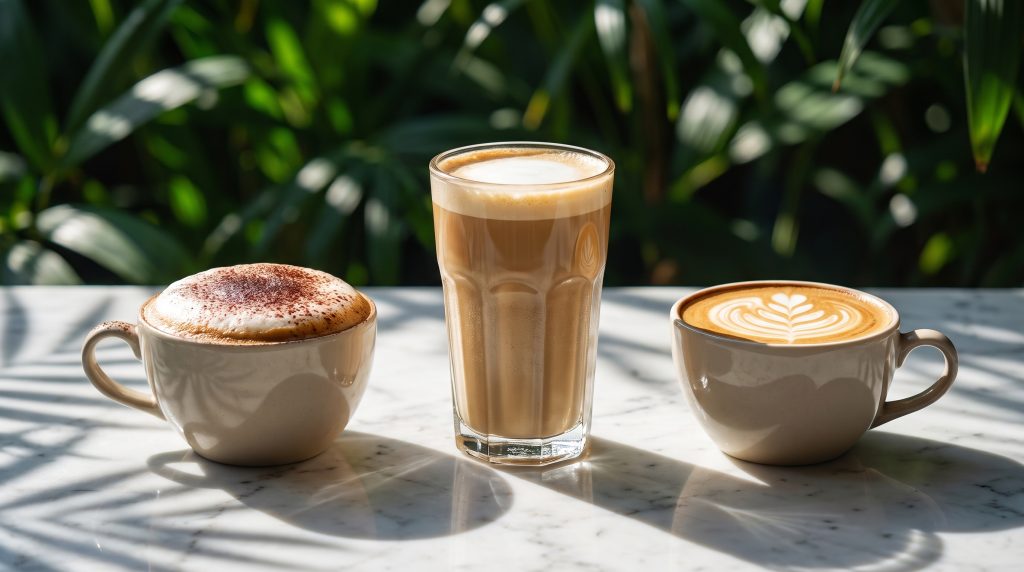
Cappuccino vs latte vs flat white: what’s the difference?
The main differences are foam and milk volume. A cappuccino is equal thirds espresso, steamed milk, and milk foam — around 180ml total, with a thick foam top. A latte is a double espresso with around 200–240ml of milk and minimal foam — larger and milder. A flat white is a double ristretto with around 100–120ml of silky microfoam — the smallest and strongest of the three.
Three coffees, one question everyone has
These are three of the most popular coffees in Britain, and the most commonly confused. They’re all made with espresso and milk. They’re all served in cafés. But they taste and feel noticeably different — and ordering the wrong one when you’re in a hurry, or when it’s 7am, or when you finally sit down for five minutes, matters.
Here’s the clearest explanation we can give.
What is a cappuccino?
The cappuccino is Italian and dates back to early 20th-century Vienna and Trieste, though it became a global café staple in the latter half of the century. In Italy, it’s traditionally a morning drink — the Italians consider it bad form to order a cappuccino after noon, though British cafés have no such rules.
A classic cappuccino is built on the rule of thirds:
- One third espresso — typically a double shot, approximately 60ml
- One third steamed milk — around 60ml
- One third milk foam — approximately 60ml, producing a thick, velvety foam cap
Total volume: around 180ml. The foam is not dry and airy (that’s a “dry” cappuccino) — in a well-made cappuccino it should be dense, moist, and glossy, sitting proud of the cup’s rim.
The result is a drink that’s intense and creamy at the same time. The espresso comes through clearly, but the foam creates a distinctive texture — slightly heavier and more structured than either a latte or flat white.
What is a latte?
The latte — from “caffè latte”, Italian for coffee milk — is the most beginner-friendly of the three. It’s the largest and the mildest.
- Double espresso — approximately 60ml
- 200–240ml of steamed milk — a generous pour that softens and dilutes the espresso considerably
- A thin layer of foam — present but not dominant; just enough to provide a slightly creamy surface
Total volume: approximately 280–300ml. The latte is the drink that popularised coffee culture in Britain and the US in the 1990s and early 2000s — partly because its mildness made espresso-based drinks accessible to people who found coffee too bitter or strong.
It’s also the longest to drink, which makes it well-suited to sitting down at a café, working at a laptop, or taking a call. The coffee is present but the milk is the dominant texture and flavour.
What is a flat white?
The flat white originated in Australia and New Zealand — both countries claim the invention — and represents the espresso-first philosophy of Antipodean café culture.
- Double ristretto — a shorter, more concentrated espresso pull that extracts sweeter notes with less water
- 100–120ml of steamed milk, textured into fine microfoam where the bubbles are nearly invisible
- Minimal foam — the “flat” surface gives the drink its name; no thick cap, just a thin, integrated layer
Total volume: approximately 150–180ml. The flat white is the most coffee-forward of the three. The milk softens and smooths the ristretto, but the coffee flavour is front and centre throughout.
Cappuccino vs latte vs flat white: the comparison
| Cappuccino | Latte | Flat white | |
|---|---|---|---|
| Espresso | Double (~60ml) | Double (~60ml) | Double ristretto (~40–50ml) |
| Milk volume | ~60ml steamed | ~200–240ml | ~100–120ml |
| Foam | Thick (~60ml) | Thin layer | Very thin microfoam |
| Total volume | ~180ml | ~280–300ml | ~150–180ml |
| Strength | Medium-strong | Mild | Strong |
| Origin | Italy | Italy | Australia / New Zealand |
| Best for | A structured, textured experience | A long, mild coffee | Coffee-forward, concentrated |
The key differences
Foam
This is the clearest distinguisher. A cappuccino has a substantial foam cap — it’s a defining part of the drink. A flat white has almost none; its milk is integrated into a silky microfoam. A latte falls between the two, with a thin layer.
Size
The latte is considerably larger than the other two. A flat white and a cappuccino are similar in volume (roughly 150–180ml each), but feel quite different to drink because of the foam difference.
Strength and milk ratio
The flat white has the highest espresso-to-milk ratio and uses a ristretto, making it taste the most intensely of coffee. The cappuccino is next, with equal parts espresso, milk, and foam. The latte has the most milk and the mildest coffee flavour.
Texture
A cappuccino has the most textural contrast — the thick foam cap on top, the liquid coffee beneath. A flat white has the smoothest, most uniform mouthfeel because the microfoam is fully integrated. A latte is somewhere between.
Which one should you order?
Cappuccino — if you want a classic coffee-bar experience with a structured foam cap. If you want the espresso to be noticeable but balanced. If you’re the sort of person who might sprinkle cocoa powder on top (no judgement).
Latte — if you prefer a gentle, milky drink you can take your time with. If coffee is the background rather than the point. If you’re new to espresso-based drinks and want something approachable.
Flat white — if you want the coffee to be the star. If you prefer smaller drinks. If you want something strong and focused rather than long and milky.
Caffeine: are they different?
Not significantly. All three are typically made with a double shot of espresso (or double ristretto in the case of the flat white), giving approximately 126–150mg of caffeine per drink. The milk contributes nothing to the caffeine count.
The flat white feels strongest because you’re consuming the same caffeine in a smaller volume of liquid. See our caffeine in flat white guide for a full breakdown across all drinks.
Which milk works best in each?
At Framberry, oat milk is our default — and it works well in all three, with some nuance.
Cappuccino: Oat milk foams well and holds its structure in a cappuccino. The slight sweetness of oat milk pairs pleasantly with the espresso. Coconut milk is a more unusual option but produces an interesting result.
Latte: Oat milk shines here. Its natural sweetness comes through in the larger milk volume, creating a drink that tastes slightly sweet without any added sugar. It’s become many people’s preferred latte milk.
Flat white: Oat milk steams to a particularly fine microfoam — arguably better than dairy for the flat white’s characteristic texture. The result is smooth, slightly sweet, and complements the ristretto very well.
Framberry’s take
Our coffee menu includes all three — cappuccino, latte, and flat white — made with ethically sourced beans from our roaster. Oat and coconut milk are standard options. We don’t do a dry cappuccino; our aim is a properly textured, not-too-heavy foam.
We’re opening in London in 2027. Join the list.
Frequently asked questions
Which is stronger — cappuccino or flat white?
The flat white contains roughly the same caffeine but feels stronger because it’s smaller. In terms of coffee flavour per sip, the flat white is more intense.
Is a cappuccino or latte better for beginners?
A latte is typically the gentler entry point — more milk, milder flavour. A cappuccino’s texture can feel more unfamiliar at first. Try the latte first, then the cappuccino when you’re comfortable.
What’s the difference between a wet and dry cappuccino?
A “wet” cappuccino has more steamed milk and less foam. A “dry” cappuccino has more foam and less steamed milk. The classic cappuccino is the equal-thirds original.
Can I get a vegan cappuccino?
Yes — any of these drinks can be made with oat or coconut milk, making them vegan-friendly without any meaningful change in quality.
What’s the difference between a flat white and a cortado?
A cortado is equal parts espresso and steamed milk, typically smaller than a flat white and made with a standard double espresso rather than a ristretto. See our cortado guide for the full comparison.
Three coffees, one place. Framberry opens in London in 2027 — flat whites, lattes, cappuccinos, and everything in between. Join the list.