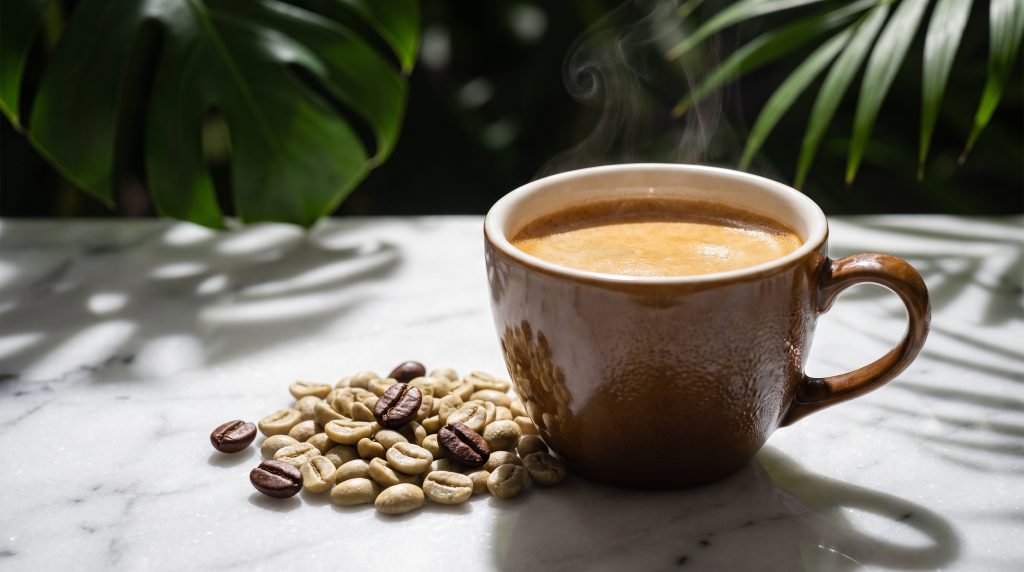
Is decaf coffee really caffeine-free?
No — decaf coffee is not completely caffeine-free. A typical decaf espresso or cup of decaf coffee contains approximately 2–5mg of caffeine, compared with around 63–150mg in a regular coffee. The decaffeination process removes most of the caffeine — usually 97–99% — but not all of it. For most people, that residual amount is negligible. For some, it matters.
The short answer
Decaf is not caffeine-free. It is very low in caffeine — low enough that most people can drink it freely without the effects they’re trying to avoid. But if you’re under strict medical advice to avoid caffeine entirely, you need to know that decaf still contains a small amount.
That said, for the vast majority of people who choose decaf — whether because of an afternoon energy cut-off, a pregnancy, a sensitivity, or simply preferring to sleep — decaf does the job very well.
How much caffeine does decaf actually contain?
A single shot of decaf espresso contains approximately 2–5mg of caffeine. A standard cup of decaf filter coffee contains approximately 2–15mg depending on the method and the bean.
Compare that to regular coffee:
- Single espresso: ~63mg
- Double espresso: ~126mg
- Flat white: ~150mg
- Filter coffee: ~80–120mg
Decaf removes roughly 97–99% of the caffeine originally in the bean. What remains is small — but it exists.
How does decaffeination work?
There are three main methods for removing caffeine from coffee beans. They differ in process, environmental impact, and effect on flavour.
1. Swiss Water Process
This is the most popular method for specialty and organic decafs. It’s entirely chemical-free.
Green (unroasted) coffee beans are soaked in hot water, which draws out the caffeine along with many of the flavour compounds. That water is then passed through activated charcoal filters, which trap the larger caffeine molecules while allowing smaller flavour molecules to pass through. The resulting “flavour-charged” water — called Green Coffee Extract — is then used to soak a new batch of beans. Because the water is already saturated with flavour compounds, it draws out caffeine without taking the flavour with it.
The Swiss Water Process is naturally decaffeinated, produces no chemical residue, and tends to preserve flavour better than solvent methods. It’s the method most commonly used by speciality roasters.
2. CO2 Process (Supercritical Carbon Dioxide)
This is the most technically advanced method and arguably the most effective at preserving flavour. Carbon dioxide is pressurised until it becomes a “supercritical” fluid — part liquid, part gas — that acts as a solvent. It’s introduced into the coffee beans and selectively bonds to caffeine molecules, drawing them out while leaving the flavour compounds largely intact.
The CO2 is then depressurised, returning to gas form and leaving no residue. The caffeine is extracted separately.
The CO2 process produces excellent-tasting decaf but requires expensive equipment, which is why it’s less common and sometimes more expensive.
3. Chemical solvent methods
The oldest and most widespread commercial decaffeination method uses chemical solvents — typically methylene chloride or ethyl acetate — to extract caffeine from the beans.
The beans are soaked in (or exposed to steam from) the solvent, which bonds preferentially to caffeine molecules. The solvent and caffeine are then removed and the beans dried. Trace solvent levels in the finished product are regulated and extremely low — well within safety limits set by food safety authorities.
Ethyl acetate, notably, is found naturally in fruit and is sometimes marketed as a “natural” decaffeination method. Methylene chloride is effective but carries more environmental questions.
Solvent methods are inexpensive and widely used. They tend to remove more flavour compounds than the Swiss Water or CO2 processes, which is one reason cheap decaf has historically tasted dull. Good decaf from a speciality roaster using Swiss Water or CO2 is a very different proposition.
Why does decaf taste different from regular coffee?
It doesn’t have to — but historically it often has. Cheaper commercial decafs use solvent processes that strip flavour along with caffeine, and they frequently use lower-grade beans on the theory that the decaffeination process masks quality differences anyway.
Good decaf, made from high-quality beans decaffeinated via Swiss Water or CO2 by a roaster who takes it seriously, is genuinely excellent. You can taste the origin characteristics of the bean — the same floral, fruity, or chocolatey notes as the regular version, without the caffeine.
The reputation of decaf as an inferior, grey, flavourless substitute is not inherent to decaf. It’s a reputation earned by low-quality decaf made by roasters who didn’t try very hard.
Does decaf have the same health benefits as regular coffee?
Mostly yes. Coffee’s health associations — its antioxidant content, its polyphenols, its potential benefits for liver health — are primarily linked to compounds other than caffeine. Decaffeination removes caffeine but leaves most of these compounds intact.
Studies have found that decaf coffee retains a substantial proportion of the antioxidants found in regular coffee, and that moderate decaf consumption is associated with similar health outcomes to moderate regular consumption in several areas.
What decaf doesn’t provide is caffeine’s acute effects: the alertness, the increased heart rate, the mild mood boost. Those are caffeine-specific.
Who should choose decaf?
Pregnant women. NHS and EFSA guidance advises pregnant women to limit caffeine to 200mg per day. A single decaf drink at 2–5mg sits very comfortably within that. For women who want to continue enjoying coffee throughout pregnancy without counting milligrams, decaf makes that easy.
People who are caffeine-sensitive. Some people metabolise caffeine slowly (due to genetic variations in the CYP1A2 enzyme) and experience anxiety, palpitations, or disrupted sleep even at moderate caffeine levels. Decaf gives them their cup of coffee without the side effects.
Evening coffee drinkers. Caffeine has a half-life of roughly 5–7 hours in most adults — meaning half the caffeine from a 3pm coffee is still in your system at 9pm. Switching to decaf in the afternoon is a straightforward way to protect sleep quality without giving up the ritual.
Anyone under medical advice. Certain medications and conditions interact with caffeine. If you’ve been advised to reduce or eliminate caffeine, decaf is a practical option — but check with your doctor about the residual 2–5mg if you’re under strict limits.
Framberry’s decaf
We offer decaf espresso across all our espresso drinks — cortado, latte, cappuccino, flat white, americano. Our decaf beans are sourced from our roaster using a process that preserves flavour rather than just removing caffeine.
A decaf flat white at Framberry is still a flat white — made with the same care, the same milk, and the same attention. The only thing missing is most of the caffeine.
We’re opening in London in 2027. Join the list.
Frequently asked questions
Can decaf coffee keep you awake?
At 2–5mg of caffeine, decaf is unlikely to affect sleep in any meaningful way for most people. However, individual sensitivities vary, and the placebo effect of expecting a stimulant is real.
Is decaf safe during pregnancy?
Yes. NHS guidance recommends limiting caffeine to 200mg per day during pregnancy. Decaf at 2–5mg per cup sits far below that limit. Always consult your midwife if you have specific concerns.
Does decaf taste worse than regular coffee?
Cheap decaf often does, because it’s made from lower-grade beans using solvent processes that strip flavour. Good-quality decaf from a speciality roaster is genuinely excellent.
Is Swiss Water Process decaf better?
It’s generally considered the best method for flavour preservation and is chemical-free, which appeals to many people. CO2 process is comparable in quality.
How much decaf is safe to drink?
The NHS doesn’t set a specific limit for decaf given its very low caffeine content. The antioxidant compounds in coffee don’t have established upper limits at typical consumption levels. Moderation, as with most things, is sensible.
Framberry serves decaf espresso drinks that actually taste good. Opening in London in 2027 — join the list.