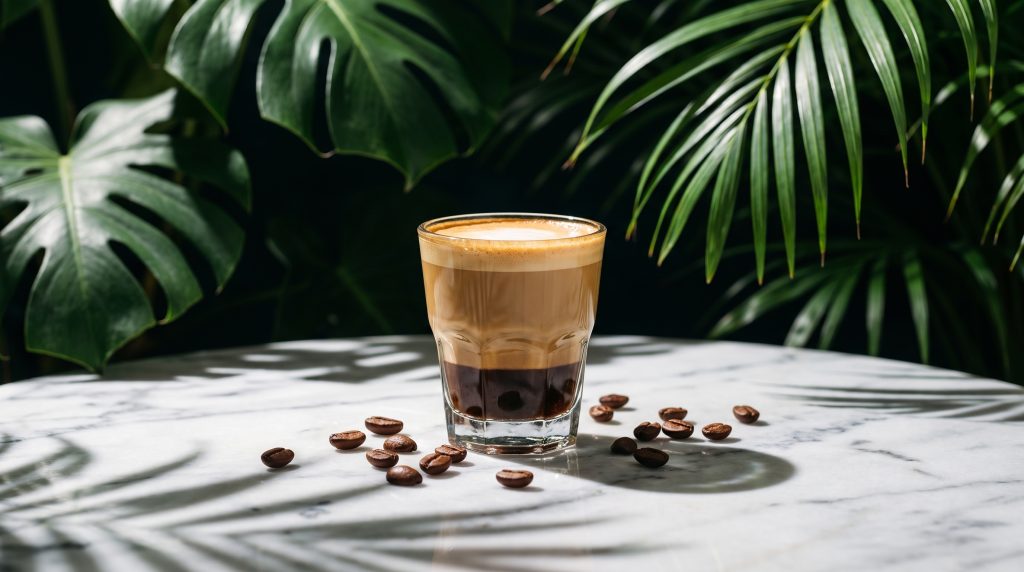
What is a cortado? The short, strong coffee explained
A cortado is a coffee drink made with equal parts espresso and steamed milk — typically 60–90ml total. The name comes from the Spanish verb “cortar”, meaning to cut: the espresso is cut with a small amount of milk to reduce its acidity and soften the intensity, without drowning the flavour in dairy.
What exactly is a cortado?
If you’ve ever wanted the punch of an espresso but with just enough milk to take the edge off, the cortado is your drink. It’s one of the simplest coffees there is: a double shot of espresso with roughly the same volume of steamed milk added. That’s it.
No enormous cup. No inch of foam. No room for extra syrup shots to get lost in. The cortado strips coffee back to what matters — the espresso — and uses milk as a precision tool rather than a filler.
Definition: A cortado is a coffee drink made with equal parts espresso and steamed milk — typically 60–90ml total. “Cortar” means “to cut” in Spanish: the espresso is cut with milk to reduce acidity and soften the flavour.
Where does the cortado come from?
The cortado originated in Spain, most likely in the Basque Country in northern Spain, where small, strong coffees are a deeply ingrained part of café culture. From there, it spread through Latin America, where it remains a coffee staple from Cuba to Argentina.
It arrived in speciality coffee shops in the UK and US during the 2010s, riding the same wave that brought flat whites and third-wave coffee culture to the British high street. Today you’ll find it on the menus of most serious coffee bars — though ask for one in a chain café and you may still be met with a blank stare.
How is a cortado made?
The process is straightforward:
- Pull a double espresso (approximately 60ml).
- Steam a small amount of milk — typically 60ml — to around 60–65°C.
- Pour the steamed milk directly over the espresso. The milk is silky rather than frothy; cortado foam is minimal.
The result is a drink of around 100–120ml total volume: small, concentrated, and served in a small glass or ceramic cup. Unlike a latte or cappuccino, there’s no attempt to create elaborate latte art on top. The cortado is about substance, not spectacle.
What does a cortado taste like?
Strong, smooth, and direct. The milk takes the sharpest edges off the espresso — the acidity and bitterness — while letting the coffee’s natural character come through clearly. You get the flavour of the espresso: its sweetness, fruitiness, or depth depending on the bean, with a rounded, creamy texture.
Compared to a latte, a cortado tastes noticeably more intense. Compared to a straight espresso, it tastes softer and more approachable. It sits neatly between the two.
How much caffeine is in a cortado?
A cortado made with a double espresso contains approximately 126mg of caffeine — the same as the espresso itself. The milk adds no caffeine; it only changes the texture and mouthfeel.
If your café makes cortados with a single shot, you’re looking at around 63mg of caffeine. At Framberry, our cortado is made with a double shot, so expect roughly 126mg.
For context, EFSA considers up to 400mg of caffeine a day safe for most healthy adults, so a double-shot cortado sits well within that. The NHS advises pregnant women to stay below 200mg. See our full caffeine guide for a drink-by-drink breakdown.
Cortado vs latte, cappuccino, flat white and macchiato
Here’s how the cortado sits alongside the coffees it’s most often confused with:
| Drink | Espresso | Milk volume | Foam | Total volume | Strength |
|---|---|---|---|---|---|
| Cortado | Double (60ml) | ~60ml steamed | Minimal | ~120ml | Strong |
| Flat white | Double ristretto | ~100–120ml microfoam | Very thin | ~160–180ml | Strong-medium |
| Cappuccino | Double (60ml) | ~60ml steamed + 60ml foam | Thick | ~180ml | Medium |
| Latte | Double (60ml) | ~200–240ml steamed | Thin layer | ~280–300ml | Mild |
| Macchiato | Single or double | Dollop or splash | Small | ~30–60ml | Very strong |
The key distinction between a cortado and a flat white is milk volume and texture: the flat white uses more milk and deliberately fine microfoam to create a smooth, velvety texture, while the cortado uses less milk with minimal foam. The flat white is also typically made with a double ristretto (a shorter, sweeter pull) rather than a standard double espresso.
The latte, by contrast, dilutes the espresso considerably — around three to four times as much milk as a cortado — making it a much milder drink that suits those who prefer coffee flavour to be a background note. You can read more in our flat white vs latte comparison and our full cappuccino vs latte vs flat white guide.
A macchiato is smaller still: an espresso with just a stain of milk or foam. The cortado is the macchiato’s more composed, even-tempered sibling.
Can you have a cortado with oat milk?
Absolutely, and at Framberry oat milk is one of our standard options. Oat milk steams well — it produces a silky, slightly sweet result that works beautifully in a cortado. The natural sweetness of oat milk pairs particularly well with espresso’s bitterness, making an oat cortado arguably even smoother than the dairy original.
Coconut milk is also available, though its more distinctive flavour makes it a bolder pairing. If you want the espresso to stay front and centre, oat is the better call.
Framberry’s cortado
At Framberry, our cortado is made with ethically sourced beans from our roaster, pulled as a double espresso and served in a small ceramic glass with steamed oat or coconut milk as standard — or whole milk if you prefer. It’s one of the simplest things on our coffee menu, which is precisely why we take it seriously.
We’re opening in London in 2027. Want to know when we open? Join the list.
Frequently asked questions
Is a cortado the same as a macchiato?
Not quite. A macchiato is an espresso with just a small stain or dollop of milk — much smaller than a cortado. A cortado uses equal parts espresso and steamed milk, making it more balanced and less intense.
How big is a cortado?
Typically 60–120ml total volume — significantly smaller than a latte (around 280–300ml) but larger than a straight espresso (30ml).
Is a cortado stronger than a flat white?
In terms of espresso-to-milk ratio, yes — a cortado is more concentrated. A flat white uses more milk and produces a slightly softer, creamier result, though both are firmly in the “strong” category.
Can you get a cortado decaf?
Yes. Any espresso drink can be made with decaf beans. Note that decaf is not completely caffeine-free — it contains around 2–5mg per shot. See our decaf guide for more.
Does a cortado have sugar?
Not unless you add it. A cortado is just espresso and steamed milk — no syrups, no sweeteners. The milk provides a slight natural sweetness.
Framberry opens in London in 2027 — serving cortados, flat whites, matcha and more. Join the list and be the first to know when we open.