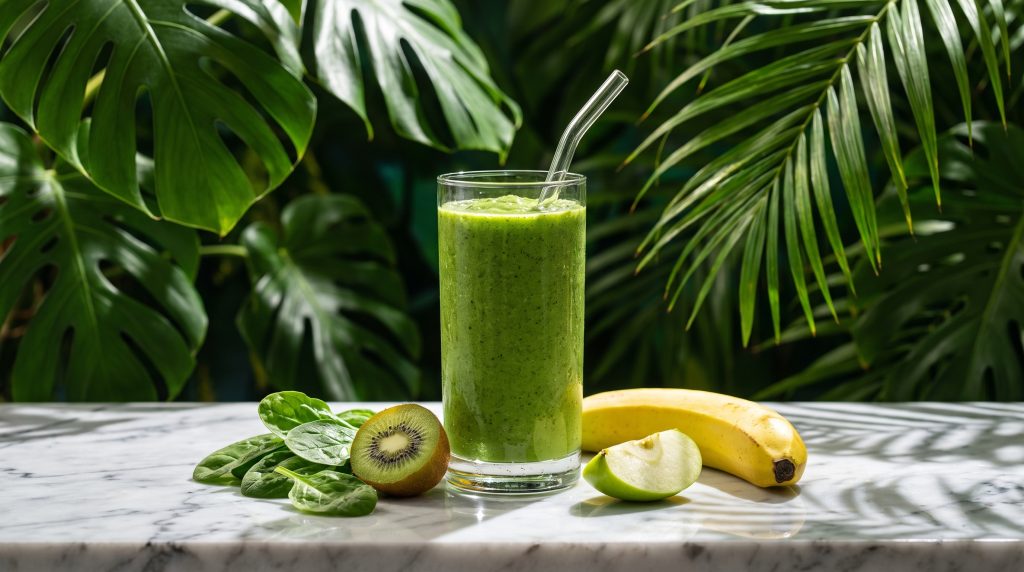
A green smoothie is just a fruit smoothie with leafy greens blended in — typically spinach or kale. Done well, it tastes of the fruit, not the field. The trick is getting the ratio right, blending the greens first, and using frozen mango or banana to balance the bitterness. Here’s the recipe, and everything else you need.
The Framberry green smoothie recipe
This is our baseline: spinach and mango, with banana for creaminess and lime to cut through the sweetness. It’s one of the more forgiving green smoothie combinations — the mango is sweet enough to balance even a generous handful of spinach.
Recipe card — Spinach and mango green smoothie
– Prep: 5 min / Total: 5 min / Serves: 1
– Ingredients:
– 1 large handful baby spinach — about 80g (2½ cups)
– 150g (about 1 cup) frozen mango chunks
– 1 medium banana
– 200ml (¾ cup) coconut milk (from a carton) or oat milk
– Juice of ½ lime
– Steps:
1. Add spinach and milk to the blender first — not the fruit. This is the single most important tip for a smooth green smoothie.
2. Blend on high for 15–20 seconds until the spinach is fully broken down and you have a bright green liquid.
3. Add mango, banana and lime juice.
4. Blend on high for a further 45–60 seconds until completely smooth. Spinach needs longer than fruit alone.
5. Taste. If you want it sharper, add a little more lime; if sweeter, a small drizzle of agave.
6. Serve over ice.
– Nutrition (approx): ~280 kcal, 50g carbs (of which ~40g natural sugars), 5g protein, 6g fibre
Why does spinach work in a smoothie?
Baby spinach has a surprisingly mild flavour — mild enough that, once blended with mango and banana, most people can’t taste it at all. This is why it’s the green of choice for smoothie beginners.
Beyond flavour, spinach contributes iron, magnesium and folate to the blend. We won’t overclaim here — the bioavailability of iron from plant sources (non-haem iron) is lower than from meat, and it’s meaningfully improved when consumed alongside vitamin C (which the lime in this recipe provides). Spinach is a worthwhile addition to your diet; it’s not a cure for iron deficiency on its own.
What spinach reliably does: turn your smoothie green, add volume without many calories, and contribute genuinely useful micronutrients as part of a varied diet.
Kale vs spinach in green smoothies
If spinach is the gentle introduction, kale is the advanced version.
Spinach:
– Mild, almost sweet flavour
– Blends smoothly, even in older or less powerful blenders
– Virtually undetectable in fruit-heavy smoothies
– Good source of iron, magnesium, folate, vitamin K
Kale:
– More assertive, slightly bitter, mildly earthy
– Tougher leaves — strip from the stem before blending; a high-powered blender handles it better
– More vitamin C than spinach; also a source of vitamin K and calcium
– Works well with cucumber, apple and lemon in a more savoury green smoothie
Our recommendation for most people: start with spinach, move to kale when you want to experiment. You can also blend the two — 60g spinach and 20g kale gives you the nutritional range of both with a manageable flavour.
The most important technique: blend greens first
We mentioned it in the recipe above, but it’s worth emphasising separately because it makes a significant difference to the result.
Adding fruit, liquid and greens all at once tends to leave small flecks of spinach or kale in the finished smoothie — particularly in standard domestic blenders. Blending the greens with just the liquid first creates a green “milk” that then incorporates the fruit seamlessly.
This matters most with kale, which is tougher than spinach. For spinach alone in a good blender, you may not notice a difference. But it’s a good habit regardless.
Variations
Green detox smoothie
Spinach, cucumber, celery, apple and lime juice. No banana, lighter on calories and natural sugars. Good as a hydrating drink rather than a meal. See our low-sugar smoothie guide for more in this vein.
Protein green smoothie
Add one scoop of vanilla pea protein to the main recipe above. The flavour changes very little — banana and mango hold their own — but you add roughly 20–22g of protein, transforming it from a snack into a post-workout meal. For more on adding protein, see our protein smoothie guide.
Green and ginger smoothie
Add a 2cm piece of fresh ginger (peeled) before the final blend. Ginger adds warmth and a mild spice that works surprisingly well with mango and lime. It’s also a popular choice for people who find green smoothies too sweet.
What about “detox” green smoothies?
Detox is one of those words the wellness industry loves and nutritional science is considerably more sceptical about. Your liver and kidneys handle the body’s actual detoxification process rather efficiently, without the need for a green juice.
What green smoothies genuinely offer: a practical way to increase your vegetable and fruit intake, particularly if you find eating a large plate of spinach unappealing. That’s a real benefit. We just think it’s better to describe it accurately than to dress it up in language that doesn’t hold up.
Framberry’s green smoothies
Spinach is one of the optional add-ins available at Framberry’s build-your-own smoothie bar. Blend it with mango, pineapple, kiwi — or anything else from our fruit menu — alongside a protein booster if you want to take it further.
Framberry opens in London in 2027. Join the list to be first in.
Frequently asked questions
Will a green smoothie taste of spinach?
Not if you make it with enough fruit. Baby spinach is mild enough that it’s essentially undetectable when blended with banana and mango. Kale has a more assertive flavour and you will taste it — that may or may not be a problem depending on how much you like kale.
How much spinach should I add to a smoothie?
60–100g is a reasonable range. A large handful (about 80g) gives you a vivid green colour and a meaningful nutrient contribution without making the flavour difficult. More than 120g starts to push through even with a full fruit base.
Is a green smoothie good for you?
It depends on what you put in it. A green smoothie with spinach, frozen fruit and oat milk is a nutritious drink — it contributes iron, magnesium, fibre, and vitamins from the greens, alongside the nutrients from the fruit. It’s not a detox or a cure for anything, but it’s a good and practical way to get more vegetables into your diet.
Can I use frozen spinach?
Yes, with a caveat. Frozen spinach works perfectly well nutritionally and blends smoothly, but it comes in dense, pre-compressed blocks rather than loose leaves, which means it’s harder to measure by eye. Use roughly 40–50g of frozen spinach as equivalent to 80g of fresh leaves.
Can I make a green smoothie without banana?
Yes — avocado provides a similar creaminess with less sweetness, and cucumber adds hydration and body. The smoothie will be less sweet overall, which some people prefer. It will also be slightly more green in flavour.
Build your own green smoothie at Framberry, opening in London in 2027. Choose your greens, your fruit, and your boosters. Join the list to be among the first through the door.