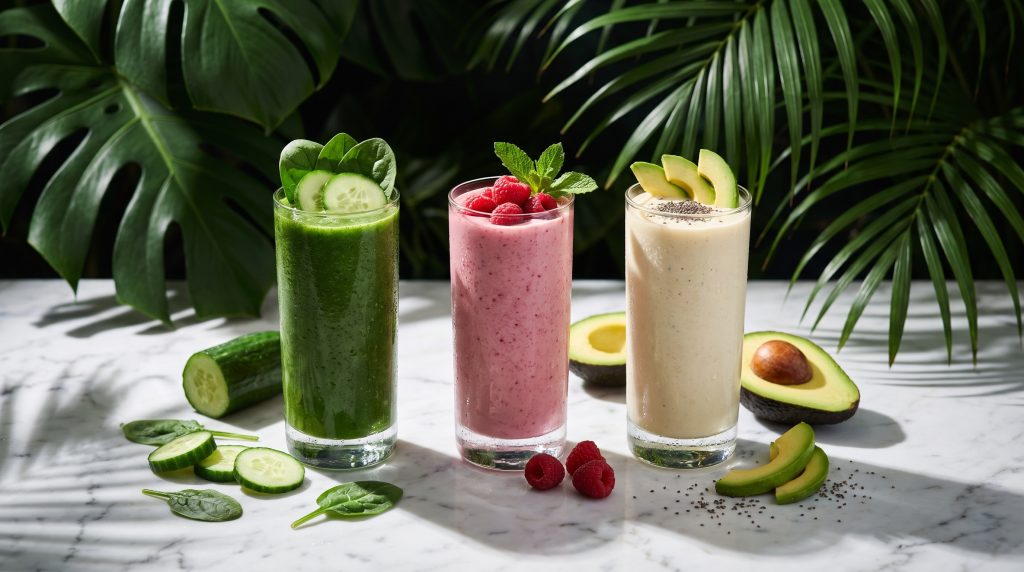
A standard fruit smoothie typically contains 35–45g of natural sugars — mostly from fruit. That’s not necessarily a problem, but if you’d prefer less, you can reduce it meaningfully by choosing lower-sugar fruits, swapping a juice base for oat milk, and adding fibre and protein to slow how the sugars are absorbed.
First, an honest word about sugar in smoothies
Smoothies often get a bad press for sugar, and sometimes it’s deserved — a large tropical smoothie from a high-street chain can contain 60–70g of sugar, more than you might expect from a “healthy” drink. But context matters, and so does what type of sugar you’re talking about.
The sugars in a whole-fruit smoothie come packaged with fibre, vitamins, minerals and water. This is meaningfully different from the same gram count in a fizzy drink or a biscuit — the fibre slows absorption, the vitamins contribute to your overall nutrient intake, and you get fullness from the volume. That said, if you’re managing blood sugar levels, counting carbohydrates for any reason, or simply prefer a lighter drink, reducing the sugar content of a smoothie is practical and straightforward.
The NHS recommends adults consume no more than 30g of free sugars per day. Free sugars are added sugars and the sugars in fruit juice and honey — not the sugars naturally present in whole fruit. A smoothie made from whole fruit sits in a nutritional grey area here: the blending process partially breaks down the cell walls that would slow sugar absorption in the way that eating a whole piece of fruit does. It’s not the same as drinking fruit juice, but it’s not the same as eating an apple, either. We think honesty about this is more useful than papering over it.
At Framberry, we don’t moralize about sugar. We list the approximate sugar content of our smoothies so you can make your own choices. That’s what this guide tries to do too.
How sugar varies by fruit
Not all fruits are equally sugary. Here’s a rough guide to natural sugar content per 100g of common smoothie fruits:
- Strawberries: ~5g sugar — among the lowest. Great smoothie fruit.
- Raspberries: ~5g sugar — also very low, with notable fibre.
- Blueberries: ~10g sugar — moderate. Rich in anthocyanins.
- Kiwi: ~9g sugar — moderate, and a good source of vitamin C.
- Pineapple: ~10g sugar — moderate, but often used in large quantities.
- Mango: ~13g sugar — relatively high, particularly concentrated frozen.
- Banana: ~12–15g sugar (increases with ripeness) — the most common smoothie sweetener, and also the highest in carbohydrates.
This doesn’t mean mango and banana are off-limits — they’re nutritious and delicious. But if reducing sugar is the goal, reducing or removing banana and replacing it with cucumber or more berries makes a measurable difference.
Practical ways to lower the sugar in a smoothie
Use berries as your main fruit. Strawberries and raspberries have roughly a third of the sugar of banana by weight. A 150g portion of mixed berries adds only 7–8g of sugar versus 14–17g for a medium banana.
Add cucumber. Cucumber is 96% water, has almost no sugar, and adds volume and a mild, clean flavour. It works surprisingly well in green and berry smoothies.
Swap fruit juice for oat milk or water. Orange juice adds roughly 8g of sugar per 100ml; oat milk adds around 3–4g per 100ml. Water adds none at all. For lower-sugar smoothies, always use milk or water as the liquid base, never juice.
Add protein and fibre. Protein and fibre both slow gastric emptying — which means the sugars in your smoothie are absorbed more gradually, avoiding a sharp spike. Adding a scoop of pea protein and a tablespoon of chia seeds will lower the glycaemic impact of a smoothie without changing its sugar content on paper.
Don’t add honey, agave or sweeteners. Most naturally sweet fruit already provides plenty of sweetness. Taste before adding anything extra.
Avoid “low-sugar” labels on flavoured yoghurts or protein powders. These often contain artificial sweeteners, which is a perfectly legitimate choice — but worth knowing about.
What does “low sugar” actually mean for a smoothie?
There’s no legal threshold for a “low-sugar” smoothie in the UK in the way there is for packaged food (which requires ≤5g total sugar per 100g to carry a “low in sugar” claim). But as a practical benchmark, a smoothie with under 20g total natural sugars per serving is meaningfully lower than the standard recipe, and one with under 12g per serving is genuinely low compared to most smoothie options.
The three recipes below fall into that first category — under 20g of natural sugars — while keeping the smoothies flavourful and worth drinking.
Three low-sugar smoothie recipes
1. Berry and cucumber smoothie
The workhorse low-sugar smoothie. Cucumber adds body and volume; berries provide flavour and antioxidants; chia seeds add fibre. It’s light and clean rather than creamy and sweet.
Recipe card
– Prep: 5 min / Total: 5 min / Serves: 1
– Ingredients:
– 100g (⅔ cup) frozen mixed berries (strawberry, raspberry, blueberry)
– 100g (about ⅓) cucumber, peeled and roughly chopped
– 200ml (¾ cup) oat milk (unsweetened)
– 1 tbsp chia seeds
– Small squeeze of lemon juice (optional, brightens the flavour)
– Steps:
1. Add cucumber and oat milk to blender first and blend briefly to break down the cucumber.
2. Add berries and chia seeds.
3. Blend on high for 60 seconds.
4. Add lemon juice if using; blend for another 5 seconds.
5. Serve immediately or refrigerate — chia seeds will thicken the smoothie as it sits.
– Nutrition (approx): ~160 kcal, 22g carbs (of which ~12g natural sugars), 5g protein, 9g fibre
2. Kiwi and spinach smoothie
Kiwi is underused in smoothies. It provides a sharp, bright flavour alongside useful amounts of vitamin C, vitamin K and fibre — and it’s relatively low in sugar compared to tropical fruit.
Recipe card
– Prep: 5 min / Total: 5 min / Serves: 1
– Ingredients:
– 2 kiwi fruits, peeled (fresh or frozen)
– 1 large handful baby spinach (~80g)
– 200ml (¾ cup) coconut water
– Juice of ½ lime
– Steps:
1. Add spinach and coconut water to blender. Blend for 15 seconds until the spinach is fully broken down.
2. Add kiwi and lime juice.
3. Blend on high for 45 seconds.
4. Taste — add more lime for sharpness or a small drizzle of agave if too tart.
5. Serve over ice.
– Nutrition (approx): ~120 kcal, 24g carbs (of which ~17g natural sugars), 3g protein, 5g fibre
Note: coconut water adds a small amount of natural sugar (roughly 6g per 200ml); swap for water if you want to reduce this further.
3. Strawberry and almond milk smoothie
Strawberries and almond milk are a natural pairing — the berries provide colour and sharpness; unsweetened almond milk is one of the lowest-sugar plant-based milks available (~1g per 100ml). The protein powder here adds substance and slows absorption.
Recipe card
– Prep: 5 min / Total: 5 min / Serves: 1
– Ingredients:
– 150g (1 cup) frozen strawberries
– 200ml (¾ cup) unsweetened almond milk
– 1 scoop (30g) vanilla pea protein powder
– 1 tbsp chia seeds
– ½ tsp vanilla extract
– Steps:
1. Add strawberries and almond milk to blender.
2. Add protein powder, chia seeds and vanilla.
3. Blend on high for 60 seconds.
4. Taste. The protein powder usually adds enough sweetness; only add agave if you find it too tart.
5. Serve immediately.
– Nutrition (approx): ~260 kcal, 22g carbs (of which ~10g natural sugars), 24g protein, 7g fibre
This is the highest-protein, lowest-sugar recipe of the three — a strong option post-workout.
Framberry’s approach to labelling
We believe in giving people real information — approximate calorie counts, sugar content, and ingredient details for everything on our menu. We don’t hide sugar behind “natural ingredients only” language, and we don’t position smoothies as sugar-free when they’re not.
That said, we also don’t lecture. A mango smoothie with 45g of natural sugar is a good drink. So is a kiwi and spinach smoothie with 17g. Both belong on a menu that genuinely caters to everyone.
Framberry is opening in London in 2027. Join the list if you’d like to be first in.
Frequently asked questions
Are smoothies high in sugar?
Standard fruit smoothies typically contain 35–45g of natural sugars per serving, primarily from fruit. This is higher than you might expect, though it comes with fibre and other nutrients. If you’d prefer less sugar, choose berry-based smoothies with a milk or water base and avoid adding honey or juice.
Is the sugar in smoothies bad for you?
Natural sugars in whole fruit come packaged with fibre, vitamins and minerals, which affects how they’re absorbed. That said, the blending process partially breaks down cell walls, so a smoothie digests somewhat faster than whole fruit. For most people in good health, the sugar in a smoothie is not a problem — but if you’re managing blood sugar for medical reasons, it’s worth discussing with a healthcare professional.
What is the lowest-sugar smoothie I can make?
A blend of cucumber, frozen raspberries or strawberries, and unsweetened almond milk or water will give you the lowest natural sugar count — potentially under 10g per serving. It won’t taste of much if you only use those three; a squeeze of lemon and a few mint leaves help considerably.
Can I use sweeteners in a low-sugar smoothie?
You can. Sweeteners like stevia or erythritol add sweetness without contributing sugar. Whether to use them is a personal choice — they’re considered safe by UK food standards. At Framberry, we don’t use them; we rely on the natural sweetness of fruit.
How does Framberry handle sugar labelling?
We aim to provide approximate nutritional information for all our smoothies, including sugar content, so you can make informed choices. We believe people deserve honest information rather than vague health language.
At Framberry, we list what’s in our smoothies — including approximate sugar content — because we think you deserve to know. Opening in London in 2027. Join the list.