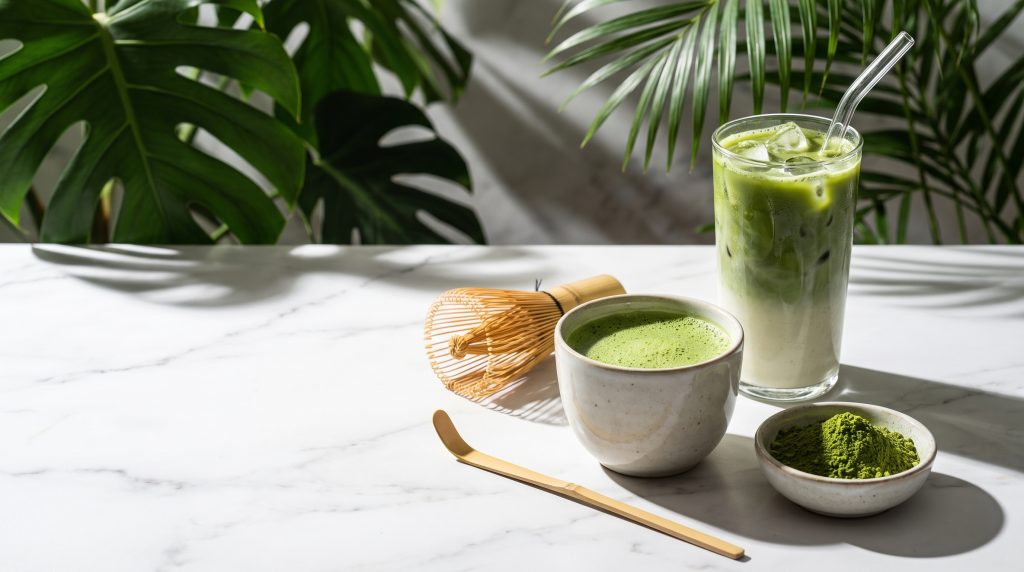
Matcha is a type of powdered green tea made by stone-grinding whole shade-grown tea leaves into a fine powder. Unlike brewed tea, you consume the entire leaf, which means more caffeine (around 38–70mg per serving) and a higher concentration of antioxidants. It has an earthy, slightly sweet, umami flavour — and yes, it really is that green.
What is matcha?
Matcha is powdered green tea — but that simple description undersells it considerably. The word itself comes from the Japanese “ma” (ground) and “cha” (tea). What makes matcha different from ordinary green tea is that you grind the entire dried tea leaf into a fine powder, then whisk that powder into water or milk. You don’t steep and discard; you drink the whole leaf.
That distinction matters. Brewed green tea extracts some compounds from the leaf and leaves the rest behind. Matcha delivers everything the leaf contains — chlorophyll, caffeine, amino acids, and a family of antioxidants called catechins — in every sip.
The result is a drink with a flavour and a nutritional profile that no brewed tea quite matches (no pun intended). It has a deep, grassy, slightly sweet, umami character that can be surprising if you’re expecting something like an ordinary cup of green tea. Some people love it on first sip. Others take a week or two. Most end up devoted.
How matcha is made
The journey from tea plant to your cup takes months and involves several deliberate steps that define matcha’s character.
Shade-growing. About three to four weeks before harvest, farmers cover the tea plants — blocking roughly 90% of sunlight. This stresses the plant in a productive way. Deprived of light, it produces more chlorophyll (giving matcha its vivid green colour) and more L-theanine, an amino acid we’ll return to shortly. It also slows growth, concentrating flavour in the leaves.
Harvesting. Only the youngest, most tender leaves are picked — typically by hand, typically in spring. This first harvest is called “first flush” and produces the finest, sweetest leaves. Later harvests use older, tougher leaves with a more bitter profile.
Steaming and drying. After picking, leaves are steamed almost immediately to halt oxidation (which would turn them brown and alter their flavour). They’re then dried.
Sorting and de-stemming. Stems and veins are removed, leaving behind what’s called “tencha” — the raw material for matcha. This step is labour-intensive and affects the final quality.
Stone-grinding. Tencha is ground slowly in traditional granite stone mills. Speed matters here: too fast generates heat, which degrades the delicate compounds. A single stone mill can produce only 30–40g of matcha powder per hour. That’s part of why good matcha isn’t cheap.
Packaging. Matcha oxidises and loses flavour quickly when exposed to light, air, and heat. Good producers package in airtight, opaque tins and recommend use within a few weeks of opening.
Ceremonial vs culinary grade: what’s the difference?
Walk into any speciality food shop and you’ll find matcha labelled “ceremonial grade” at £20–50 per 30g and “culinary grade” at a fraction of the price. The difference is real and worth understanding.
Ceremonial grade uses leaves from the first harvest — the youngest, shade-grown tips. It’s stone-ground to a finer texture, brighter green in colour, and noticeably sweeter with less bitterness. It’s designed to be drunk as a standalone tea, whisked with water, in the traditional way. Framberry uses ceremonial-grade Japanese matcha because the flavour needs to hold up without anything to hide behind.
Culinary grade comes from later harvests and sometimes blended leaves. It’s more bitter, darker in colour, and less expensive. That bitterness isn’t a flaw in context — it holds up well when baked into a cake, blended into a smoothie, or used in a sauce where other flavours are present. For drinking straight, though, it tends to be harsh.
See our dedicated guide on ceremonial vs culinary matcha for a full comparison with tasting notes.
What does matcha taste like?
Matcha is earthy, vegetal, and umami, with a pleasant sweetness at the finish if you’re drinking a quality ceremonial-grade powder. It’s often described as grassy, and that’s accurate — but not in an unpleasant way. Think fresh garden herbs rather than cut lawn.
The bitterness level depends heavily on grade and preparation. Ceremonial matcha whisked with water at 80°C will be smooth and nuanced. Culinary grade steeped in boiling water can taste quite sharp. Temperature matters: boiling water denatures the amino acids responsible for sweetness. Always use water at about 80°C.
When milk is added — oat or coconut in our case — the flavour mellows considerably. A matcha latte reads more like a creamy, faintly earthy drink with green tea notes. Our strawberry matcha adds a light fruit sweetness that works particularly well iced on a warm London morning.
Matcha vs coffee: caffeine and energy
This is the question we hear most. Here’s an honest comparison.
| Matcha (2g serving) | Espresso (1 shot) | Flat white (double shot) | |
|---|---|---|---|
| Caffeine | 38–70mg | ~63mg | ~150mg |
| Energy onset | 20–40 min | 15–30 min | 15–30 min |
| Duration | 4–6 hours | 3–5 hours | 3–5 hours |
| L-theanine | Yes (~10–20mg) | No | No |
| Taste | Earthy, umami, sweet | Bitter, roasted | Creamy, bitter |
| Calories (black/plain) | ~5 | ~5 | ~150 (with milk) |
The key difference isn’t just caffeine quantity — it’s what accompanies it. L-theanine is an amino acid found in green tea leaves that, some studies suggest, may work in combination with caffeine to support calm, sustained focus while moderating the jittery side-effects that caffeine alone can produce. The research is promising rather than definitive, but many regular matcha drinkers describe the energy as cleaner and more even than coffee — without the sharp peak or the crash.
Neither is universally better. If you need to wake up fast before a 6am run, a flat white will get there more quickly. If you want sustained focus for three hours of deep work without grinding your teeth, matcha tends to serve people better. Many people drink both — and that’s exactly what we designed our menu for.
For a full head-to-head, see our post on matcha vs coffee.
Matcha benefits: what the science says
We’re not going to tell you matcha cures anything or treats any condition. We’re a smoothie bar, not a clinic. But there is legitimate research worth summarising honestly.
Antioxidants. Matcha is particularly high in a catechin called EGCG (epigallocatechin gallate). Catechins are a type of antioxidant, and some studies suggest they may support cell health. The concentration in matcha is notably higher than in brewed green tea, because you’re consuming the whole leaf.
L-theanine and focus. As noted above, some research suggests that the combination of caffeine and L-theanine may support sustained attention and reduce caffeine-related anxiety. A 2017 review in Nutritional Neuroscience found positive effects on attention and alertness from this combination, though more large-scale human trials are needed.
Blood glucose. Some studies suggest green tea catechins may support healthy blood glucose management, but this evidence is preliminary and should not be interpreted as a substitute for medical advice.
Calorie content. Plain matcha whisked with water is around 5 calories per serving. A matcha oat latte adds the calories of the milk (roughly 100–130 for oat milk). It’s not a diet product, but it’s a lower-calorie option than many coffees when prepared simply.
What the science does not support: claims that matcha “detoxes” the body, “cleanses” the liver, or prevents specific diseases. Those claims are not substantiated by good evidence, and you won’t find them here.
For more on the evidence, see is matcha good for you?
How to make a matcha latte at home
You don’t need a traditional tea set. Here’s the method that reliably produces a smooth latte.
What you need:
– 2g ceremonial-grade matcha powder (roughly 1 level teaspoon)
– 60ml water, heated to 80°C (just off the boil, rested for two minutes)
– 200ml oat milk (or your preferred milk)
– A bamboo whisk, small electric frother, or jar to shake
Method:
1. Sift the matcha powder into a small bowl or glass to break up any clumps.
2. Add the 80°C water and whisk vigorously in a W or M motion — not circular — until no lumps remain and a light froth forms on the surface. This takes about 30–45 seconds.
3. Steam or froth your milk. Oat milk froths particularly well.
4. Pour the frothed milk over the matcha concentrate.
5. Serve hot, or pour over ice for an iced matcha latte.
No bamboo whisk? No problem — a small electric milk frother works well. A jar-shaking method also works for iced versions. See our full guide on how to make matcha without a whisk for five alternative methods.
The quality of your matcha powder matters more than your equipment. A fine, bright green ceremonial-grade powder will produce a smooth latte. A dull, coarse powder will taste bitter regardless of technique.
Is matcha safe for everyone?
For most people, yes — in sensible amounts. The NHS advises a maximum of 200mg of caffeine per day during pregnancy, so if you’re pregnant, one serving of matcha (38–70mg) can fit within that guidance, but you should speak to your midwife about your total daily caffeine intake from all sources. A single matcha latte at Framberry contains roughly the same caffeine as a cup of home-brewed tea.
Matcha contains vitamin K, which can interact with blood-thinning medications such as warfarin. If you’re on anticoagulants, speak to your GP or pharmacist.
Some people are sensitive to caffeine in general. If coffee makes you anxious or disrupts your sleep, matcha may be gentler — but it still contains caffeine. Opt for a decaf option or our caffeine-free drinks like lemonades and herbal teas if you’d rather avoid it entirely.
For a more detailed look at daily matcha intake, see how much matcha per day and how much caffeine is in matcha.
Where to try real matcha in London
There’s no shortage of places selling matcha in London — but quality varies enormously. The difference between a ceremonial-grade matcha whisked to order and a scoop of culinary powder stirred into milk is significant in both flavour and in the nutrients you actually consume.
At Framberry, we use ceremonial-grade Japanese matcha and prepare every drink to order. We offer it hot or iced, as a traditional thin tea or as a latte, and with a strawberry variation that’s become something of a signature. Our oat milk is the default; coconut milk is available too.
We’re opening in London in 2027 — join the list to find out when and where.
Frequently asked questions
What is matcha made of?
Matcha is made from whole green tea leaves that have been shade-grown, dried, and stone-ground into a fine powder. The leaves used for matcha come from the Camellia sinensis plant — the same plant used for all tea. What makes matcha distinct is that the entire leaf is consumed, rather than steeped and discarded.
Is matcha better than green tea?
Matcha and green tea come from the same plant, but matcha delivers a higher concentration of caffeine, antioxidants, and L-theanine because you consume the whole ground leaf rather than an infusion. For nutritional density, matcha has the edge. For a lighter, lower-caffeine drink, brewed green tea is a reasonable choice.
Does matcha have more caffeine than coffee?
A standard matcha serving (2g) contains roughly 38–70mg of caffeine. A single espresso contains approximately 63mg. A flat white with a double shot contains around 150mg. So a single serving of matcha typically has less caffeine than a flat white, and a similar amount to a single espresso — though the L-theanine in matcha may make the energy feel different.
Why is good matcha so expensive?
Ceremonial-grade matcha involves labour-intensive shade-growing, hand-harvesting young leaves, and slow stone-grinding at a rate of only 30–40g per hour per mill. The process is resource-intensive and yields a limited amount of product, which is reflected in the price.
Can I drink matcha if I’m pregnant?
The NHS recommends keeping total caffeine intake under 200mg per day during pregnancy. A serving of matcha contains roughly 38–70mg, so one serving typically fits within that limit — but you should account for all other caffeine sources and speak to your midwife about what’s right for you.
We use ceremonial-grade Japanese matcha in every drink — no culinary shortcuts. Framberry is opening in London in 2027. Join the list to be first to know where.