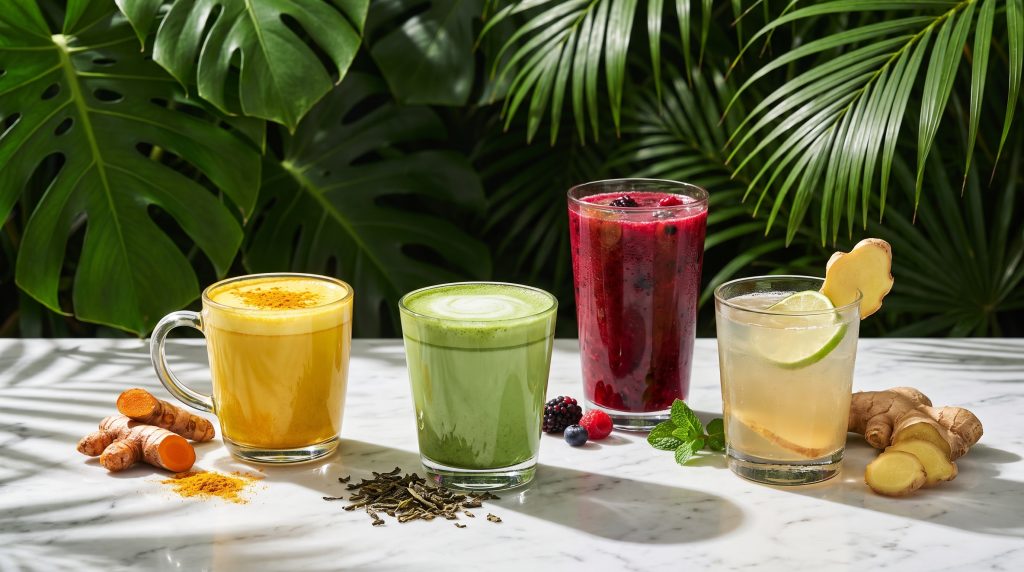
Wellness drinks are beverages designed — or at least marketed — to support health beyond basic hydration. The category includes matcha, smoothies, functional teas, protein shakes, and more. Some have solid evidence behind them. Others are mostly marketing. This guide cuts through the noise, with a particular focus on drinks that actually work for active people and run-club mornings.
What are wellness drinks?
“Wellness drink” is a broad term with no regulated definition. At one end, it includes drinks with a clear and well-understood nutritional profile — matcha, whole-fruit smoothies, protein shakes. At the other, it includes a vast category of products whose health claims range from plausible to fanciful.
The common thread is intention: wellness drinks are chosen not just for taste or social ritual, but at least in part because the drinker believes they offer something extra. That belief might be well-founded or it might not be. The drink that genuinely contains amino acids, antioxidants, or protein is not in the same category as an expensive sparkling water with a few milligrams of ashwagandha and a wellness-coded label.
This guide will help you understand which drinks are genuinely worth your attention, what the evidence says about functional ingredients, and what to reach for depending on what you’re doing — whether that’s a morning workout, a long run, a desk day, or a post-studio wind-down.
Non-alcoholic and sober-curious: a shift in how people drink
Something has changed in the past several years. The cultural assumption that socialising requires alcohol has started to crack. Sober October, Dry January, and the broader sober-curious movement have moved from niche lifestyle choices to mainstream conversation. A significant proportion of younger adults — particularly in the UK — are actively reducing their alcohol intake or giving it up altogether.
The result is a growing demand for drinks that feel special, considered, and pleasurable — without alcohol. Not just water with ice. Not just a diet cola. Something that has been thought about, has flavour complexity, and holds its own at a table of adults.
That’s a gap the wellness drinks category is well-positioned to fill, and it’s part of why Framberry exists. Our entire menu is non-alcoholic — not because we have an agenda about alcohol, but because we think there should be excellent, considered, non-alcoholic options that stand up on their own terms.
A Piña Colada served in a real pineapple is a convivial, shareable, genuinely pleasurable drink. So is a strawberry matcha over ice. So is a lavender lemonade. None of them require justification. They’re just good.
Functional ingredients explained
The wellness drinks market loves the word “functional” — meaning a drink that does something specific beyond hydrating you. Here’s a brief, honest rundown of the ingredients most commonly used, and what the evidence actually says.
Caffeine. Well-understood and genuinely effective. Caffeine improves alertness, attention, and physical performance at doses of around 3–6mg per kilogram of body weight. It’s the most effective natural performance ingredient available, and it’s in your morning coffee, your matcha, and your tea. The evidence base for caffeine is among the strongest of any functional ingredient.
L-theanine. An amino acid found in green tea leaves, including matcha. Some studies suggest that, combined with caffeine, it may support calm, sustained attention and moderate jitteriness. Research is promising but the body of evidence is smaller than for caffeine alone. Worth noting that matcha delivers both in a single cup.
Antioxidants. A broad category that includes polyphenols, catechins (particularly EGCG in matcha), and anthocyanins (in berries). Antioxidants are associated with supporting cell health, and some studies suggest diets high in antioxidant-rich foods may support long-term health outcomes. The precise mechanisms are complex and the science continues to develop. Eating (and drinking) a wide variety of colourful fruit and vegetables is a well-supported approach.
Protein. Protein’s role in muscle repair, satiety, and metabolic function is among the most well-established in nutrition science. A protein-containing smoothie or shake post-workout supports muscle recovery. This is not controversial.
Electrolytes. Sodium, potassium, and magnesium are lost in sweat. For exercise lasting longer than 60–90 minutes, or in hot conditions, replacing electrolytes matters more than just rehydrating with water. Natural sources include coconut water, fruit (banana for potassium), and a small amount of salt. Many commercial electrolyte drinks also contain considerable sugar, so check the label.
Adaptogens (ashwagandha, rhodiola, etc.). The evidence here is much more mixed and in many cases preliminary. Some studies suggest ashwagandha may support stress response and exercise performance; others show modest or null results. We don’t currently use adaptogens in our drinks, because the evidence doesn’t yet meet the bar we’d want before making claims.
Collagen. Popular in wellness drinks, particularly for skin. The evidence is limited and contested. The body doesn’t absorb collagen peptides intact — they’re broken down like other proteins — so the mechanism by which topical skin benefits might arise is not straightforward. We’d want to see more robust evidence before recommending this.
A useful rule of thumb: if an ingredient has been used safely for centuries (matcha, green tea, whole fruit), there’s usually a reasonable body of evidence to draw on. If it’s a synthesised compound that’s appeared on labels in the past five years, treat the marketing claims with appropriate caution.
The best drinks after a run or workout
This is one of the most practical questions in exercise nutrition, and the answer is less complicated than the wellness industry suggests.
First priority: rehydrate. Water. Simple, effective, necessary. For runs under an hour in mild weather, water is almost always sufficient. For longer or more intense exercise, or in summer heat, consider adding electrolytes — a banana and some extra salt alongside water will cover the basics.
Second priority: carbohydrates to replenish glycogen. Your muscles run on glycogen (stored carbohydrate). After depleting it through exercise, your body is primed to replenish it. Fruit — banana, mango, berries — is a practical and effective source. A smoothie serves this function well.
Third priority: protein for repair. As discussed above, 20–40g of protein in the hours after exercise supports muscle repair. A protein smoothie or a smoothie with nut butter ticks this box.
What you probably don’t need immediately after a 5km run: a speciality supplement, an expensive recovery shake, or anything labelled specifically for “post-workout recovery” that costs £4 for a small bottle. A banana, some water, and a smoothie with protein will do the job.
Our recommendation: an oat milk smoothie with banana, berries, and a protein booster. It’s practical, real-food-based, and it takes about three minutes to put together (or less than that to order from us).
Matcha, smoothies, and coffee as wellness drinks
Not all wellness drinks need to be unusual. Some of the most evidence-backed options are also the most familiar.
Matcha is a genuine functional drink by any reasonable definition. It contains caffeine, L-theanine, and a high concentration of antioxidants. The energy it provides is sustained and, for many people, feels calmer than coffee. It’s also zero-calorie when served plain. For a focused morning without the coffee jitters, it’s a strong option.
Smoothies sit in a more contextual category. A well-built whole-fruit smoothie with protein and no added sugar is nutritious and satisfying. A juice-based smoothie with honey and no protein is much closer to a dessert. The difference is in what’s in it.
Speciality coffee is often overlooked in the wellness context, but there’s a reasonable body of research suggesting that moderate coffee consumption (2–5 cups per day for most adults) is associated with various health outcomes. The evidence for coffee and type 2 diabetes risk is among the more robust in nutrition epidemiology, though the picture is not simple or causal. Coffee is also just a pleasure, which has its own value.
Lemonades and herbal teas are hydrating, pleasant, and caffeine-free — useful for afternoons, evenings, or anyone avoiding caffeine. Our lavender lemonade and mojito lemonade are made without alcohol and served in properly considered versions.
Drinks for run clubs and fitness studios
There’s a growing overlap between the wellness drinks category and the run-club and studio community. Early-morning run clubs, yoga studios, reformer Pilates — the before-and-after ritual is part of the experience, and water from a paper cup doesn’t serve it well.
Community matters here. The post-run flat white or the matcha before a class is not purely functional — it’s social glue. It’s the reason to linger, the shared ritual, the bit that makes Tuesday at 6:45am feel worth it. That’s something we’ve thought about deeply in building Framberry. We want to be the place the run club goes afterwards. The studio’s preferred option before class. The spot where the dog is welcome and the drink is worth ordering.
We’re designing Framberry around exactly this kind of morning. The community is as much the product as the drinks.
For more on specific drinks and their benefits before or after exercise, see our guides on matcha and smoothies.
Where to find wellness drinks in London
London has a genuinely strong speciality drinks scene — particularly for matcha, coffee, and smoothies. A few things worth knowing when you’re choosing where to go:
Matcha quality varies enormously. Ask whether it’s ceremonial or culinary grade. Ask if the water temperature is controlled (it should be around 80°C, not boiling). If nobody knows the answer, that tells you something.
Smoothies are similarly variable. “Fresh” doesn’t always mean built to order — some bars use pre-blended batches or add sweeteners. If you want to know what’s in your smoothie, a place that builds to order is always preferable.
Coffee is easier to assess — a speciality café using single-origin beans and a trained barista is visible from the equipment and from the care taken in preparation.
At Framberry, we’re bringing ceremonial-grade matcha, whole-fruit smoothies built to order, and speciality coffee together under one roof — alongside a menu that’s entirely non-alcoholic and mostly vegan, in a space that’s designed to be welcoming rather than exclusionary. Families, dogs, and run clubs all equally valid.
We’re opening in London in 2027. Join the list — we’ll let you know when and where.
Frequently asked questions
What counts as a wellness drink?
There’s no regulated definition, but the term generally refers to beverages chosen at least in part for their nutritional content or functional ingredients, rather than purely for taste or social ritual. Matcha, smoothies, protein shakes, herbal teas, and coconut water all fit the description. Many commercial “wellness drinks” also fall into this category — with widely varying levels of evidence for their specific claims.
What’s the best drink after a workout?
Start with water to rehydrate. For runs or sessions over an hour, add some electrolytes — a banana and a pinch of salt will cover the basics. A smoothie with protein is a practical and effective post-workout option: the fruit replenishes glycogen and the protein supports muscle repair. You don’t need a specialist product.
Are wellness drinks suitable for sober-curious people?
Many wellness drinks are naturally non-alcoholic — matcha, smoothies, coffee, lemonades, herbal teas. The sober-curious movement has also driven growth in sophisticated non-alcoholic options. At Framberry, the entire menu is non-alcoholic by design, not as an afterthought.
Is matcha a wellness drink?
Yes, by most reasonable definitions. Matcha contains caffeine, L-theanine, and a high concentration of antioxidants. Some studies suggest the combination of caffeine and L-theanine may support sustained focus. It’s one of the more evidence-backed options in the wellness drinks category.
What should I drink before a run?
For shorter runs (under an hour), water or a small coffee/matcha around 45–60 minutes before works well for most people. Caffeine is one of the more thoroughly studied performance supplements. Avoid heavy food or a large smoothie immediately before — your body needs blood flow in your muscles, not your digestive system. A light snack and a matcha around an hour beforehand is a sensible routine.
Framberry is being built around exactly this kind of community — run clubs, studios, mornings, and the drink worth sticking around for. We’re opening in London in 2027. Join the list.