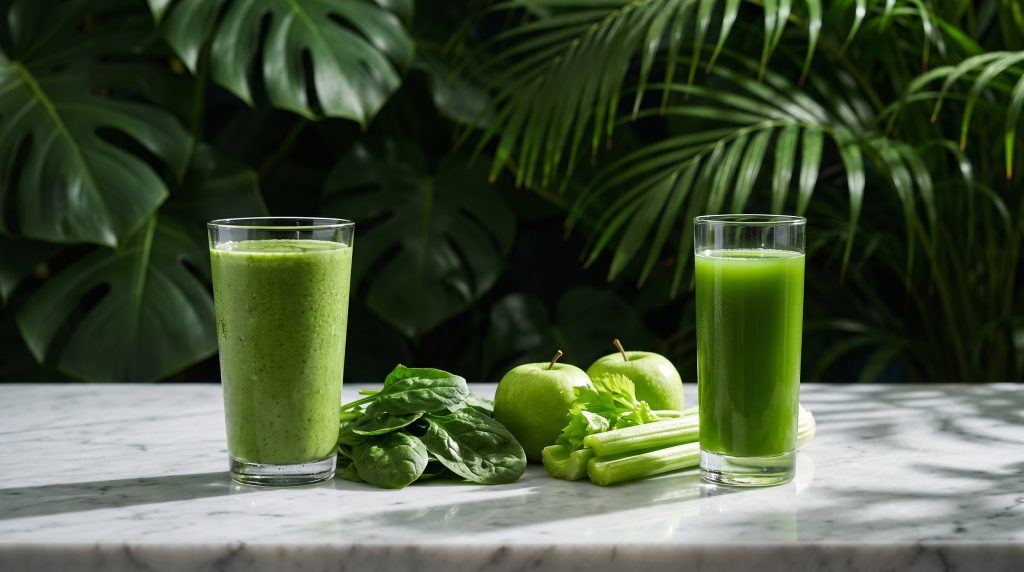
Smoothie vs juice: which is actually healthier?
For most people, most of the time, a smoothie is the better choice. The reason comes down to one ingredient: fibre. A well-made smoothie retains the fibre from whole fruit. Juicing removes most of it. That single difference has meaningful knock-on effects on how sugar is absorbed, how full you feel afterwards, and how satisfying the drink is overall.
But the full answer is more nuanced than “smoothies good, juice bad.” Here is the complete comparison.
The key difference: what happens to fibre
When you blend fruit into a smoothie, the fruit cell walls are broken down and the contents are liquefied — but the fibre itself remains in the drink. You consume all of it.
When you juice fruit, the liquid is extracted and the pulp (which contains most of the fibre) is discarded. What remains is primarily water, vitamins, minerals, and natural sugar.
Fibre matters for two reasons in this context:
1. Blood sugar response. Fibre slows the rate at which sugar is absorbed from your digestive system into your bloodstream. This means that 40g of natural sugar consumed in a smoothie — where fibre is present — is absorbed more gradually than the same 40g from juice, where the fibre has been removed. The practical effect is a more gradual energy rise rather than a sharper spike.
2. Satiety. Fibre makes you feel fuller for longer. A smoothie tends to keep you satisfied more effectively than the same calories from juice, which is one reason it is a better choice as a meal companion or replacement.
The comparison table
| Factor | Smoothie | Juice |
|---|---|---|
| Fibre | Retained (whole fruit blended) | Mostly removed (pulp discarded) |
| Natural sugar content | Moderate (varies by fruit) | Higher per ml (concentrated) |
| Vitamins and minerals | Well retained | Well retained (though some lost with heat pasteurisation) |
| Calories (per 250ml) | ~120–160 kcal (fruit + water base) | ~100–130 kcal (pure fruit juice) |
| Satiety | Higher (due to fibre) | Lower |
| 5-a-day count | Maximum 1, regardless of volume | Maximum 1, regardless of volume |
| Ease of making at home | Moderate (blender needed) | Requires a juicer, or buy ready-made |
| Blood sugar impact | More gradual absorption | Faster absorption (lower fibre) |
Both count as a maximum of one of your 5-a-day, which is an important and frequently misunderstood point.
The 5-a-day rule for both
The NHS states that 150ml of unsweetened smoothie or fruit juice counts as one of your 5-a-day. No matter how much you drink beyond that, it still counts as one. This applies equally to smoothies and juice.
The reasoning behind this is sensible: fruit and vegetables in whole form take longer to eat and are naturally portion-limited. Smoothies and juices allow you to consume a large volume quickly, and the guidelines are designed to encourage variety across the day rather than ticking off all five in a single glass.
So if someone tells you that their morning green juice is fulfilling their entire daily fruit and vegetable requirement, the NHS guidance politely but firmly disagrees — as does our full smoothie health guide.
When juice makes sense
Juice is not without its merits. There are specific situations where it is a reasonable or even preferable choice:
Easier digestion. Some people find very high-fibre drinks hard on their digestive system. Juice, with its lower fibre content, is gentler and may be preferable for people with certain digestive conditions. (This is a reason to consult your GP or dietitian rather than to avoid fibre in general.)
Post-exercise window. In the immediate post-exercise period, rapidly absorbed carbohydrates and sugars can be useful for replenishing glycogen. Juice’s faster sugar absorption, usually a limitation, becomes a minor advantage here.
Flavour concentration. Good-quality cold-pressed juice, particularly vegetable-forward blends, can achieve flavour intensities and combinations that smoothies cannot. A cold-pressed celery, apple, and ginger juice is doing something different from a smoothie version of the same ingredients — it is more concentrated, more intensely flavoured, and a different experience entirely.
Variety. If you already eat plenty of whole fruit and vegetables, a glass of juice is a pleasant addition without being problematic. The issue only really arises when juice replaces a varied whole-food diet rather than complementing it.
Why Framberry makes smoothies
At Framberry, we make smoothies rather than juices, and the reason is exactly the one outlined above: whole fruit wins on fibre and satiety. We want people to feel genuinely well after drinking something from our bar — not to have a brief energy rush followed by a slump.
That said, we are not anti-juice in a dogmatic sense. If you want a great juice, there are excellent juice bars that do it brilliantly. We just think that for a daily drink, the case for keeping the fibre is compelling enough to build an entire menu around.
Take a look at what we offer — real fruit, plant milk bases, and build-your-own booster options. For more on building the most nutritious version, see our post on the healthiest smoothie formula.
The verdict
Smoothies generally win for:
– Everyday nutrition
– Satiety and fullness
– Blood sugar balance
– Meal replacement use
Juice may be preferable for:
– Ease of digestion (in specific circumstances)
– Post-exercise rapid carbohydrate replenishment
– Concentrated flavour intensity
– When fibre intake from other sources is already very high
The answer that smoothies are healthier than juice is generally correct, but “juice is bad” is too blunt. The most honest framing is: for most people, in most contexts, keeping the fibre by choosing a smoothie is the better call. A glass of good-quality, 100% fruit juice is not harmful. It just is not as nutritionally complete as a comparable smoothie.
Frequently asked questions
Q: Is blending or juicing better for weight management?
A: Smoothies tend to be more useful for weight management because the fibre makes them more filling, which can reduce overall calorie intake across the day. Juice, being less filling, is easier to consume in addition to other food without realising the calorie contribution. That said, neither is a weight management tool in isolation.
Q: Does freshly squeezed juice count the same as pressed juice?
A: Nutritionally, freshly squeezed juice retains more vitamins than heat-pasteurised juice. Cold-pressed juice retains more than either, as the lower processing temperature preserves heat-sensitive nutrients like vitamin C. Both count the same for 5-a-day purposes.
Q: Can I get the benefits of both by mixing them?
A: You can add a small amount of juice to a smoothie for flavour without losing significant fibre. Using 50–100ml of juice alongside blended whole fruit and a milk base is a reasonable middle ground.
Q: Is green juice the same as a green smoothie?
A: No. A green juice is extracted from fruit and vegetables, with the pulp removed. A green smoothie blends the whole ingredients together. The green smoothie retains far more fibre. Both can be nutritious; the fibre difference is the key distinction.
Q: Are vegetable juices healthier than fruit juices?
A: Vegetable juices tend to be lower in sugar than pure fruit juices, which is a meaningful advantage. Cold-pressed green vegetable juice (cucumber, celery, spinach, apple) is a low-sugar, nutrient-dense option that is close in character to a light smoothie — though still without the fibre you would get from blending.
We are on team smoothie — for the fibre, the flavour, and the fact that they actually keep you going until lunch. See our full smoothies menu for the range. Framberry opens in London in 2027. Join the list to be among the first.