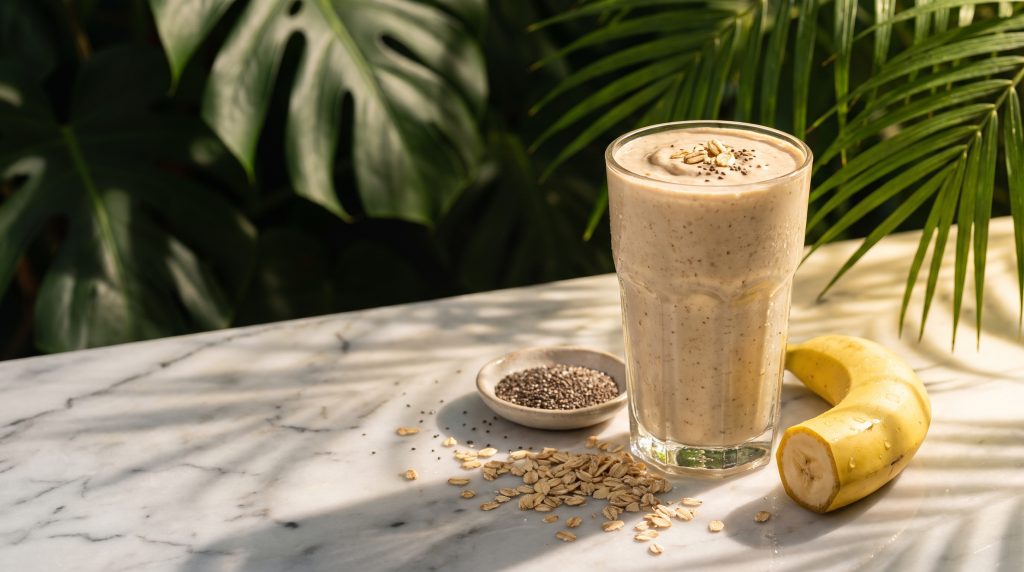
A good breakfast smoothie needs protein, fibre and healthy fat — not just fruit and milk. The combination of all three is what makes the difference between a drink that leaves you hungry by ten o’clock and one that carries you comfortably through to lunch. This recipe does that, and takes five minutes to make.
What makes a good breakfast smoothie?
The three things that keep you full after a meal are protein, fibre and fat. Each works differently. Protein triggers satiety hormones. Fibre slows digestion and stabilises blood sugar. Fat takes longer to digest than carbohydrates, extending the feeling of fullness.
Most standard fruit smoothies have plenty of carbohydrates but relatively modest protein, fat and fibre. That’s why they can feel satisfying in the moment but leave you ready for another snack a couple of hours later. The fix isn’t complicated: add oats (fibre and slow-release carbs), nut butter (fat and protein), and chia seeds (fibre and omega-3s), and the same fruit smoothie becomes a genuinely sustaining breakfast.
The overnight oat breakfast smoothie
Soaking oats overnight is optional — the smoothie works perfectly well with dry rolled oats, and a high-speed blender will handle them — but soaked oats blend more smoothly and give the finished smoothie a slightly silkier texture. If you’re making it in the morning without pre-planning, just add an extra 20 seconds to your blending time.
Recipe card
– Prep: 5 min / Serves: 1 (soak oats overnight if preferred)
– Ingredients:
– 40g (½ cup) rolled oats (soaked overnight in 100ml oat milk, or dry)
– 1 medium banana
– 150ml (⅔ cup) oat milk (in addition to soaking liquid)
– 1 tbsp almond butter
– 1 tsp chia seeds
– ½ tsp cinnamon
– Steps:
1. If prepped overnight: drain the soaked oats (or leave the liquid in — it all goes into the blender) and add to your blender.
If not prepped: add dry rolled oats to the blender and blend with the oat milk for 20–30 seconds before adding other ingredients.
2. Add banana, remaining oat milk, almond butter, chia seeds and cinnamon.
3. Blend on high for 60 seconds until completely smooth.
4. If the smoothie is too thick — it should be thick — add a splash more oat milk and blend for another 10 seconds.
5. Drink immediately, or pour into a flask if commuting.
– Nutrition (approx): ~380 kcal, 55g carbs (of which ~20g natural sugars), 12g protein, 10g fat, 8g fibre
A note on the numbers: this smoothie is more calorie-dense than a standard fruit smoothie. It’s designed to replace breakfast, not accompany it.
What about meal replacement smoothies?
A breakfast smoothie and a meal replacement smoothie are essentially the same thing — the marketing language differs more than the nutritional concept. If a smoothie contains enough protein, fat, fibre and calories to replace a meal, it’s a meal replacement.
The recipe above is close to that standard: around 380 kcal, 12g protein, 10g fat, 8g fibre. If you wanted to push the protein higher — for a post-workout breakfast, for example — adding a scoop of pea protein would take it to approximately 32g of protein and 500 kcal, which is a solid meal. See our protein smoothie guide for more on adding protein.
Three breakfast smoothie variations
Berry breakfast smoothie
Swap the banana for 150g of frozen mixed berries and use the same oats, almond butter and chia seeds. Lower in natural sugar, higher in antioxidants. The colour is a deep pink-purple and the flavour is tangier — add a drizzle of honey if you prefer it sweeter.
Mango and coconut breakfast smoothie
Replace 100ml of the oat milk with coconut milk (from a carton). Add 150g of frozen mango instead of banana. The result is tropical and creamy — a good choice if you find oat-and-banana combinations a bit heavy in the morning. For more on mango smoothies, see our mango smoothie guide.
Protein breakfast smoothie
Add one scoop of vanilla pea protein and reduce the oats to 25g. You get roughly 30g of protein and 460 kcal — more protein-forward, slightly less fibre-heavy. Ideal if you’re heading to the gym within an hour or two of breakfast.
Framberry and breakfast
We’re building Framberry as a morning destination, not just a post-workout stop. A smoothie that carries you through the morning, alongside a good speciality coffee, is the basis for a civilised start to the day.
We’re opening in London in 2027. Join the list and we’ll let you know the moment we’re ready.
Frequently asked questions
Is a breakfast smoothie healthy?
It depends entirely on what’s in it. A smoothie made with oats, nut butter, chia seeds and fruit — like the recipe above — is a nutritious and sustaining breakfast. A smoothie made only from fruit juice and frozen fruit is more of a sweet snack. The key is including protein, fat and fibre alongside the carbohydrates.
Can I make a breakfast smoothie the night before?
Yes, with a couple of caveats. Chia seeds will continue to absorb liquid overnight, thickening the smoothie considerably — you may need to add more milk in the morning. The colour may dull slightly (particularly in berry versions), and some separation is normal. Shake or stir before drinking.
How many calories should a breakfast smoothie have?
This depends on your overall needs. As a rough guide, most adults eat breakfast in the 300–500 kcal range. The recipe above (380 kcal) sits comfortably within that range. If you’re using a smoothie to replace a larger meal or as a post-workout breakfast, 450–550 kcal is reasonable.
Can I use instant oats instead of rolled oats?
Yes, though rolled oats give a slightly better texture in a smoothie — they blend to a smoother result when soaked. Instant oats work fine dry; just be aware they absorb liquid faster, so your smoothie may become very thick. Start with 30g rather than 40g.
If the idea of a Framberry smoothie as your morning routine sounds right, join the list and be among the first to visit when we open in London in 2027.