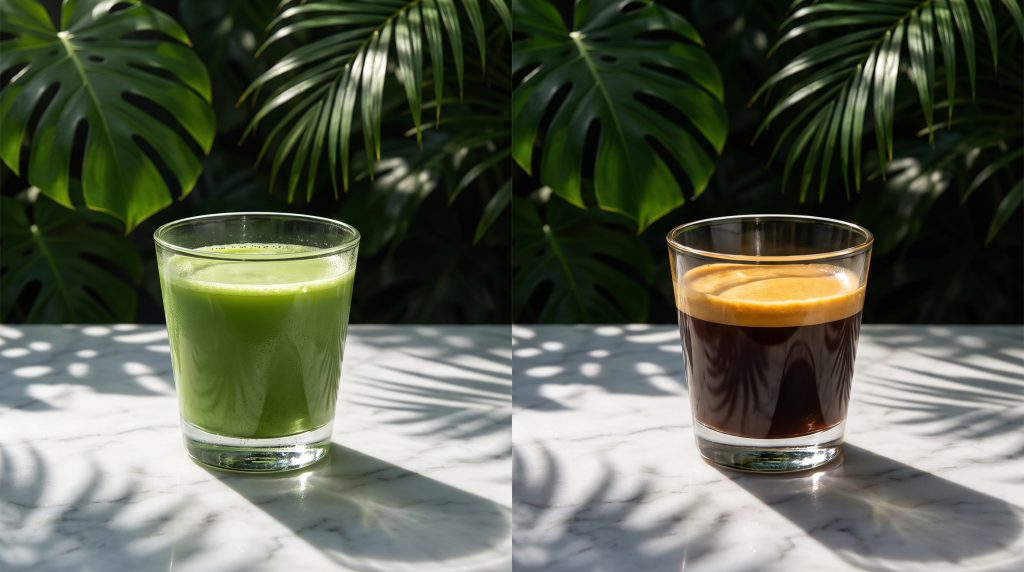
Coffee vs matcha for energy: which one’s better?
Coffee provides a faster, stronger energy boost — typically felt within 15–30 minutes, peaking quickly and lasting 3–5 hours. Matcha provides a calmer, more sustained lift that comes on more gradually and tends to hold for 4–6 hours. The difference comes down to caffeine dose and L-theanine — an amino acid in matcha that tempers caffeine’s sharper edges. Neither is universally better; they suit different moments.
The question
“Should I have coffee or matcha?” is increasingly a real daily decision for a lot of people. Both contain caffeine. Both are consumed for energy and focus. But they don’t feel the same — and the science gives a reasonably clear explanation of why.
This isn’t a post about which one is healthier in a broad sense — we cover that in our matcha vs coffee comparison. This is specifically about energy: how each drink affects alertness, how long the effect lasts, and when each one makes the most sense.
The caffeine difference
Caffeine is the primary driver of energy in both drinks, but the doses are meaningfully different.
Coffee:
– Single espresso: ~63mg
– Double espresso / flat white / latte: ~126–150mg
– A strong filter coffee: ~80–120mg
Matcha:
– A standard ceremonial-grade matcha (2g powder): approximately 40–70mg
A flat white contains roughly two to three times the caffeine of a matcha. This is significant — caffeine’s effects are dose-dependent, and a higher dose produces a stronger, faster, more pronounced response.
How coffee energy works
Caffeine works by blocking adenosine receptors in the brain. Adenosine is the chemical that builds up over the day and makes you feel sleepy; when caffeine blocks its receptors, the tiredness signal is suppressed and you feel more alert.
In coffee, this effect arrives relatively quickly — within 15–30 minutes of drinking — and tends to peak 30–60 minutes after consumption. The energy is noticeable and fairly abrupt. Most people describe the coffee lift as a clear “on” feeling.
The flip side is that the effect fades at a similar speed. Caffeine has a half-life of roughly 5–7 hours in most adults, meaning the body gradually clears it. As it clears — particularly if you’ve had a high dose — some people experience what’s colloquially called a “crash”: a return of tiredness that can feel more acute than the pre-coffee baseline. This is more common at higher caffeine doses and in people who are sensitive to caffeine.
How matcha energy works
Matcha contains caffeine — but it also contains L-theanine, an amino acid found in tea leaves that has a notable interaction with caffeine.
L-theanine promotes alpha-wave activity in the brain — associated with a calm, alert mental state — and appears to moderate some of caffeine’s more stimulating effects, including the tendency to cause anxiety or jitteriness at higher doses. The combination of caffeine and L-theanine is sometimes described as producing “calm focus” or “alert relaxation” — a less jittery, more even form of alertness than caffeine alone.
In matcha, L-theanine is present in relatively high concentrations — particularly in ceremonial-grade matcha, where the tea leaves have been shade-grown in ways that increase L-theanine content. The typical matcha cup contains somewhere between 25–60mg of L-theanine alongside 40–70mg of caffeine.
The energy effect of matcha tends to:
– Come on more gradually — 20–40 minutes after drinking
– Feel calmer and less abrupt than coffee
– Last longer — often described as 4–6 hours of sustained, level focus
– Produce less of a crash at the end, because the dose is lower and the effect more gradual
Coffee vs matcha energy: the comparison
| Coffee (flat white) | Matcha (2g ceremonial) | |
|---|---|---|
| Caffeine | ~150mg | ~40–70mg |
| L-theanine | Negligible | ~25–60mg |
| Onset | 15–30 minutes | 20–40 minutes |
| Peak | 30–60 minutes | 60–90 minutes |
| Duration | ~3–5 hours | ~4–6 hours |
| Crash risk | Higher (at higher doses) | Lower |
| Best time of day | Morning / early afternoon | Morning, midday, or later afternoon |
The crash question
The “caffeine crash” is real, though it varies considerably between individuals. It’s most common with high-caffeine drinks consumed in a single hit, in people who haven’t eaten, and in those who already consume a lot of caffeine (making the adenosine rebound more significant).
A double-shot flat white at ~150mg caffeine is more likely to produce a noticeable energy dip 3–4 hours later than a matcha at 40–70mg. This doesn’t mean coffee causes crashes and matcha doesn’t — it means the higher dose and faster onset of coffee makes the rebound more pronounced for some people.
If you notice energy dips in the early afternoon after a morning coffee, switching to matcha or taking your coffee with food (which slows caffeine absorption) are both practical responses.
The best time of day for each
Coffee is well-suited to the morning — particularly if you need a prompt, clear lift to start the day. Many people find their morning flat white or americano is the most effective because adenosine has built up overnight. Coffee also works well before tasks that require sharp, short-term focus.
One practical note: cortisol, a hormone involved in alertness, naturally peaks between roughly 8–9am and 12–1pm in most people. Some researchers suggest waiting until cortisol levels begin to drop — around 9:30–11:30am — before your first coffee, to avoid redundancy with the body’s natural alertness system. Whether that’s worth adjusting your routine is up to you.
Matcha works at almost any time of day due to its lower caffeine content and more gradual effect. It’s a particularly good afternoon drink for people who want sustained focus in the 2–5pm window without the risk of disrupting evening sleep. The lower caffeine dose means it’s less likely to affect sleep if consumed in the early afternoon.
What about having both?
There’s no rule against it. Some people have a coffee in the morning and matcha in the afternoon — using coffee’s faster lift for the first part of the day and matcha’s more sustained, gentler effect for the midday stretch. At Framberry, you can have exactly that.
The one thing worth watching is total daily caffeine intake. EFSA considers up to 400mg of caffeine a day safe for most healthy adults. A double-shot coffee (150mg) plus a matcha (55mg) puts you at around 205mg — well within range. Add another coffee and you’re approaching the upper end. The maths is worth doing if you’re having multiple drinks across the day.
At Framberry
We serve ceremonial-grade Japanese matcha alongside our full espresso coffee range. Both are made with care. We don’t have a view on which one you should drink — that’s genuinely a matter of what you need at a given moment.
We’re opening in London in 2027. For more on our matcha range, see our matcha menu. For the full matcha vs coffee comparison, see our matcha vs coffee guide. Join the list to hear when we open.
Frequently asked questions
Does matcha give you more energy than coffee?
No — coffee contains more caffeine and produces a stronger, faster energy effect. Matcha’s energy is calmer and longer-lasting, but less intense. Which is preferable depends on the situation.
Why doesn’t matcha give me the jitters like coffee does?
L-theanine in matcha appears to moderate caffeine’s more stimulating effects, including the tendency to cause anxiety or restlessness at higher doses. The lower caffeine dose also helps.
Can I drink matcha and coffee on the same day?
Yes, in most cases. Watch your total daily caffeine intake — EFSA considers up to 400mg a day safe for most healthy adults. A coffee plus a matcha is typically well within that.
Is matcha or coffee better for focus?
Coffee tends to produce sharp, immediate focus; matcha produces more sustained, calm focus. For creative or long-duration work, many people find matcha preferable. For urgent tasks requiring quick alertness, coffee wins.
Which is better for sleep?
Matcha, given its lower caffeine dose, is less likely to disrupt sleep if consumed in the early afternoon. Both should generally be avoided 6+ hours before bedtime if sleep is a concern.
Coffee in the morning. Matcha in the afternoon. Both at Framberry, opening in London in 2027. Join the list.