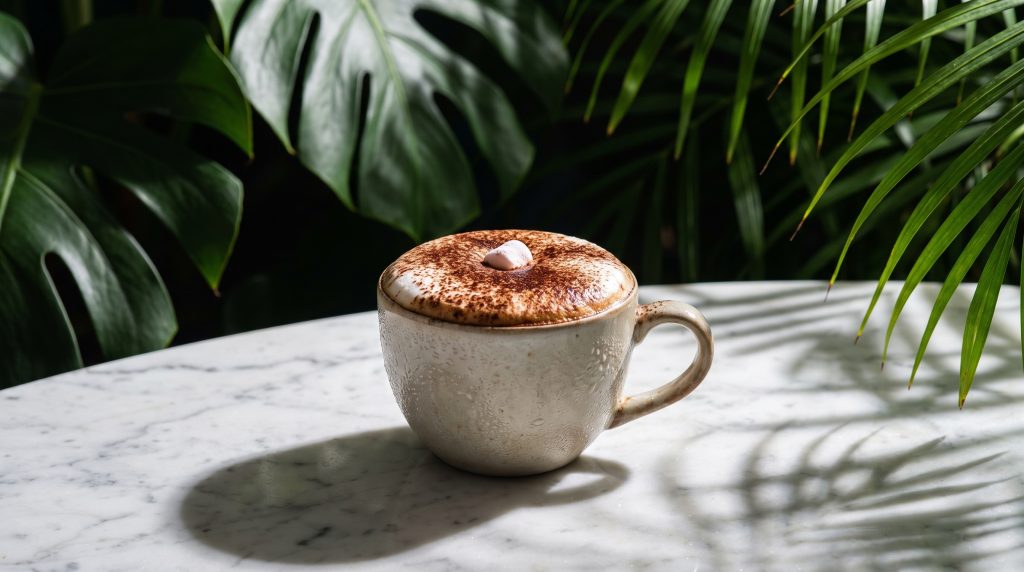
What is a babychino?
A babychino is a small cup of warm frothed milk — sometimes topped with a pinch of cocoa powder or a mini marshmallow — made specially for children. It contains no coffee and no caffeine whatsoever. It is, in every meaningful sense, a cappuccino with all the grown-up bits left out.
That is the short answer. But if you have ever handed a toddler a miniature cup of something warm and frothy and watched their face, you already know the long answer has more to do with belonging than beverages.
What is a babychino made of?
The recipe is wonderfully simple: warm frothed milk, served in a small cup, usually around 60–100ml. That is it. The milk is heated gently — not boiled — and frothed until it has a soft, velvety foam on top. At most cafés, including Framberry, it is served lukewarm rather than hot, so little hands can hold the cup safely.
The optional extras are:
- A pinch of cocoa powder dusted on the foam (decorative; the quantity is tiny)
- A mini marshmallow placed on top
- A sprinkle of cinnamon in some cafés
None of these additions contain coffee. None contain caffeine in any meaningful amount. The cocoa powder is a garnish, not an ingredient — you would need quite a lot more of it before it registered as a caffeine source.
Milk options: Framberry offers dairy-free alternatives — oat milk or coconut milk — so children who are lactose intolerant or whose families prefer a plant-based option are equally welcome. Oat milk froths beautifully and produces a very similar result to whole milk.
Is a babychino caffeine-free?
Yes, emphatically and completely. A babychino contains no coffee, no espresso, no tea, and no energy-derived ingredients of any kind. The NHS advises that caffeine is not recommended for children under 12, and a babychino is designed with exactly that in mind.
The name — a portmanteau of “baby” and “cappuccino” — can occasionally cause confusion, because a cappuccino is very much an espresso drink. A babychino simply borrows the aesthetic: the small cup, the frothy top, the café ritual. The coffee itself has been left entirely out of the picture.
If you see a café offering a babychino and you are uncertain what goes into their version, it is always worth asking. At Framberry, ours is warm frothed milk only, served lukewarm, with a dusting of cocoa or a marshmallow if you would like one.
Babychino vs babyccino: is there a difference?
The spelling varies — “babychino” and “babyccino” are used interchangeably across the UK, and you will encounter both on café menus. There is no meaningful difference in what they refer to: both mean the same small, caffeine-free, frothed-milk drink for children. “Babyccino” is slightly more common in Australian café culture, where the drink originated, while “babychino” tends to be the preferred spelling in the UK. Framberry uses “babychino.”
You may also see the drink described as a “baby cappuccino” in some places. This means the same thing, though it is worth noting that a real cappuccino contains espresso — so it is always worth double-checking what a café means if the menu wording is ambiguous.
How old do children need to be to have a babychino?
There is no firm age rule, because a babychino is simply warm milk. Warm milk is appropriate for children who are already drinking cow’s milk as part of their diet — generally speaking, toddlers aged one year and above. For children under 12 months, breast milk or formula remains the appropriate primary drink; whole cow’s milk as a main drink is usually introduced from around 12 months, in line with NHS guidance.
The dairy-free version — oat milk or coconut milk — is suitable for children over one year as part of a varied diet, though it is not nutritionally equivalent to cow’s milk or formula for very young children.
If you have any questions about what is right for your child at a particular age, your health visitor or GP is the best person to ask.
The ritual of belonging
There is something quietly lovely about the babychino that goes beyond ingredients. It gives children their own version of the café moment — the small cup, the foam, the sitting around a table with grown-ups. No one is left out. No one is drinking juice out of a carton at the side while the adults have something more interesting.
Cafés can feel like adult spaces. One of the things we wanted to get right at Framberry was making sure that every member of the family — and we mean every member, including the dog, but more on that elsewhere — feels as welcome as the person ordering a flat white.
Our babychino is free with any adult drink. We serve it lukewarm so it is safe for small hands and small mouths. It comes in a proper little cup. And if the child wants the marshmallow on top, they get the marshmallow on top.
What makes a good babychino?
A few things separate a thoughtfully made babychino from a cup of warm milk that has been half-heartedly waved near a steam wand:
Temperature. Lukewarm is the goal — around 50–55°C at most. Children’s mouths are more sensitive to heat than adults’, and a babychino should be safe to drink immediately, not something that needs five minutes to cool on the table.
Texture. A proper froth makes a difference. Silky, micro-foam rather than large bubbles gives a satisfying texture and makes the drink feel considered rather than thrown together.
Size. A babychino should be small — 60–100ml is the standard. Part of the charm is the miniature scale. A large cup of warm milk is just warm milk; a small cup of it is an occasion.
Milk quality. Whole milk froths best and has the most satisfying flavour for children. Oat milk is the best dairy-free alternative for frothing. Both work well.
Babychinos at Framberry
Framberry is opening in London in 2027. Our babychino is made with warm frothed whole milk (or oat/coconut milk for dairy-free), served lukewarm in a small cup, with cocoa powder or a marshmallow on top if you would like one. It is free with any adult drink — because café culture should include everyone.
You can find out more about our kids’ menu option on the babychino menu page.
Frequently asked questions
Q: Does a babychino have caffeine?
A: No. A babychino contains no coffee, no tea, and no caffeine. It is warm frothed milk only.
Q: Is babychino spelled “babyccino”?
A: Both spellings are used — “babychino” and “babyccino” refer to the same drink. Framberry uses “babychino.”
Q: Can I get a dairy-free babychino?
A: Yes. Framberry uses oat milk or coconut milk as dairy-free alternatives, both of which froth well and taste great.
Q: Is a babychino suitable for toddlers?
A: Yes, for toddlers who are already drinking cow’s milk or a suitable alternative. It is not recommended as a primary drink for infants under 12 months. When in doubt, check with your health visitor or GP.
Q: What is the difference between a babychino and a baby cappuccino?
A: They refer to the same thing — a small, caffeine-free, frothed-milk drink for children. The term “baby cappuccino” can occasionally cause confusion because real cappuccinos contain espresso; a babychino contains none.
Framberry is opening in London in 2027 — and every child who comes in gets a babychino free with any adult drink. Join the list to be first to know when we open.