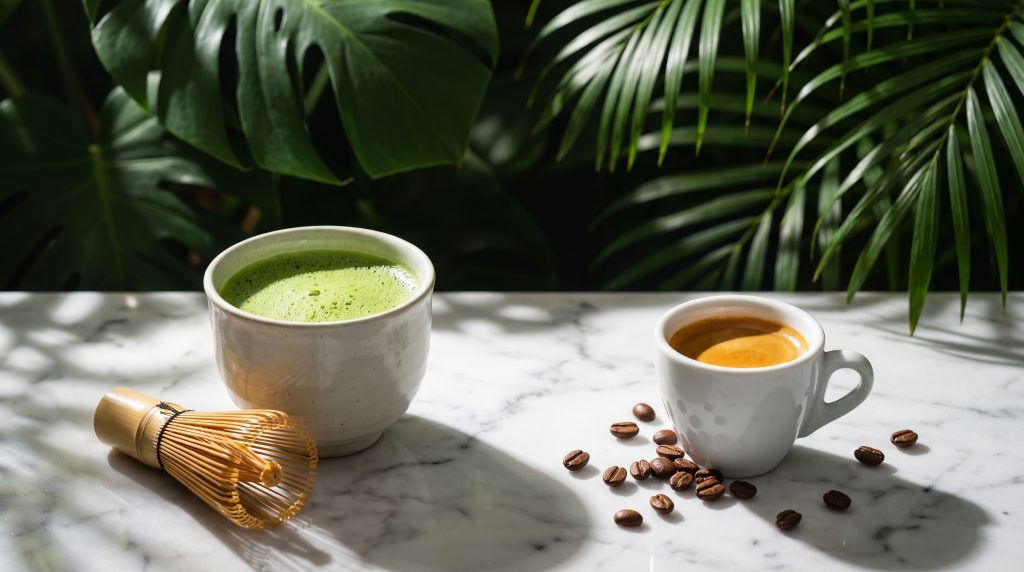
Matcha contains roughly 38–70mg of caffeine per 2g serving, plus L-theanine — an amino acid that some studies suggest may support calm, sustained focus while moderating the jitteriness that caffeine alone can produce. Coffee delivers 63–150mg of caffeine depending on preparation, with a faster, stronger hit. Neither is universally better — it depends what you need from the drink.
The comparison at a glance
Before going into detail, here’s the side-by-side:
| Matcha (2g serving) | Espresso (1 shot) | Flat white (double shot) | |
|---|---|---|---|
| Caffeine | 38–70mg | ~63mg | ~150mg |
| L-theanine | Yes (~10–20mg) | No | No |
| Energy onset | 20–40 minutes | 15–30 minutes | 15–30 minutes |
| Energy duration | 4–6 hours | 3–5 hours | 3–5 hours |
| Energy curve | Gradual, sustained | Sharp peak | Sharp peak |
| Taste | Earthy, umami, slightly sweet | Bitter, roasted, complex | Creamy, rich, bitter |
| Antioxidants | High (EGCG catechins) | Present (lower levels) | Present (lower levels) |
| Calories (black/plain) | ~5 | ~5 | ~5–10 (espresso only) |
| When to choose | Deep work, calm focus, post-workout | Quick wake-up, fast energy | High energy demand, intense morning |
How caffeine works differently in each drink
The caffeine in a shot of espresso reaches your bloodstream relatively quickly — most people notice the effect within 15–30 minutes. The energy curve is sharp: a clear lift, followed by a gradual decline. For some people, particularly those sensitive to caffeine, this can mean jitteriness, an elevated heart rate, and sometimes anxiety. The crash, when it comes, can be real.
Matcha contains less caffeine in a typical serving than a flat white, but what it also contains is L-theanine — an amino acid found in green tea leaves that is not present in coffee. Some studies suggest that L-theanine, in combination with caffeine, may support calm, sustained attention while reducing the anxious edge that caffeine alone can produce. The energy rise in matcha is generally described by regular drinkers as more gradual, and the duration is often perceived as longer without a pronounced crash.
The science on L-theanine is promising rather than definitive. A 2008 study in Biological Psychology found that the caffeine-L-theanine combination improved speed and accuracy on attention tasks and reduced susceptibility to distraction compared to caffeine alone. A 2015 paper in Psychopharmacology showed similar positive effects on cognition and mood. More large-scale human trials would strengthen the evidence base, but the research direction is consistent.
Does matcha give you energy like coffee?
Yes, but differently. This is the question most people are really asking when they compare the two.
If you’ve drunk coffee every morning for ten years and you switch to matcha, the effect will feel different. Matcha will not wake you up as abruptly. It will not produce the same sharp, definitive alertness in the first 20 minutes. What many people find is that after 30–40 minutes, they’re focused and energised — sometimes more so than with coffee — and that the state lasts longer without a hard crash at the end.
For early mornings with a specific job to do — a fast meeting, a commute, a demanding first hour — coffee tends to serve better. For sustained focus across a longer block of time, many people prefer matcha. This is not a rule; individual responses to caffeine vary considerably. But as a generalisation, it holds up.
Taste: an honest comparison
Taste is subjective, but the flavour profiles are genuinely different and worth understanding.
Coffee — particularly espresso — is bitter, roasted, and complex. The flavour comes primarily from the Maillard reaction during roasting, which produces hundreds of aromatic compounds. It’s an acquired taste for most people, though one that’s extremely widely acquired.
Matcha is earthy, vegetal, and umami, with a pleasant sweetness at the finish — particularly in high-quality ceremonial-grade matcha. It’s often described as grassy, which is accurate but not unpleasant in the way that description might suggest. Think fresh herbs rather than lawn clippings.
When milk is added to either, the character softens considerably. A matcha latte and a flat white are much closer in the “accessible, creamy” territory, though they remain distinctly different in flavour.
Neither is objectively better. Many people drink both — a coffee in the morning, a matcha in the afternoon — and the two serve genuinely different purposes.
Which should you choose?
Choose matcha if:
– You want sustained focus without jitteriness
– You’re sensitive to caffeine or find coffee makes you anxious
– You’re working on a long task and want energy that doesn’t peak and crash
– You want something with a different flavour profile
– You’re reducing caffeine intake but still want some
– It’s mid-afternoon and you want energy without disrupting your sleep (matcha’s lower caffeine content may be easier to time)
Choose coffee if:
– You need to be alert quickly — within 20–30 minutes
– You’re used to the flavour and simply enjoy it
– You need a higher caffeine dose (for example, before an intense workout)
– It’s the morning and you want the faster onset
Choose both if: you’re at Framberry, where the matcha and the coffee are on the same menu.
At Framberry, we serve ceremonial-grade Japanese matcha alongside speciality coffee — americano, flat white, cappuccino, latte, cortado, and decaf — all with oat or coconut milk as standard. Neither drink requires you to justify choosing it.
We’re opening in London in 2027. See our matcha menu and coffee menu.
Frequently asked questions
Does matcha have more caffeine than coffee?
No, typically less. A 2g matcha serving contains approximately 38–70mg of caffeine. A single espresso contains approximately 63mg. A flat white (double shot) contains approximately 150mg. Matcha has less caffeine than most coffee drinks but contains L-theanine, which may change how the caffeine is experienced.
Is matcha better than coffee for anxiety?
Some people find matcha easier to tolerate if they’re prone to caffeine-induced anxiety, because L-theanine may help moderate that response. However, matcha still contains caffeine, and if you’re sensitive to caffeine, you may still experience some of its effects. Decaf coffee or caffeine-free options are the right choice if caffeine is a significant concern.
Can I have both matcha and coffee in the same day?
Yes, as long as your total daily caffeine intake remains within sensible limits. EFSA considers up to 400mg a day safe for healthy adults, and the NHS advises no more than 200mg a day for pregnant women. One matcha (38–70mg) plus one flat white (150mg) puts you well within that range.
Is matcha or coffee better for working out?
Both contain caffeine, which some studies suggest is one of the most effective performance supplements for endurance and strength exercise. Coffee provides a faster, higher-dose hit that may be useful before a short, intense workout. Matcha’s sustained release may suit longer sessions. Neither is dramatically superior — personal preference and timing matter.
If you’ve only ever had one of the two, the other might surprise you. Both are on our menu at Framberry — opening in London in 2027. Join the list.