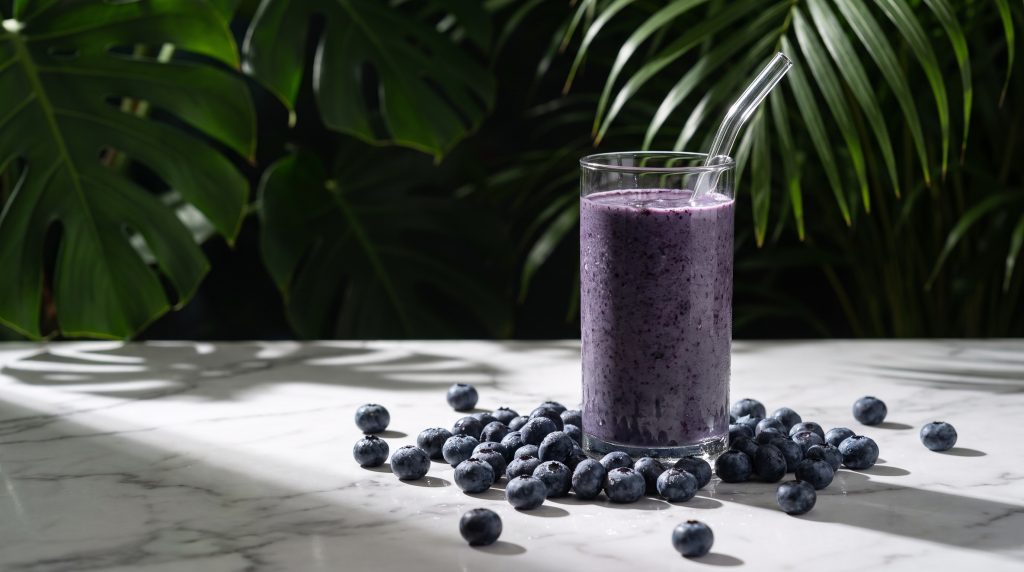
Blend frozen blueberries, a banana, and oat milk for 45 seconds and you have one of the prettiest smoothies going — deep blue-purple, naturally sweet, and thick enough to eat with a spoon if you keep the liquid down. Here’s the full recipe, a few worthwhile variations, and what blueberries actually bring to the glass.
The blueberry smoothie recipe
Recipe card
– Prep: 5 min / Total: 5 min / Serves: 1
– Ingredients:
– 150g (about 1 cup) frozen blueberries
– 1 small banana
– 200ml (¾ cup) oat milk
– 1 tbsp chia seeds (optional)
– Small handful baby spinach — about 20g (optional)
– Steps:
1. Add blueberries and banana to your blender.
2. Pour in the oat milk.
3. Add chia seeds and spinach if you’re using them.
4. Blend on high for 45 seconds until smooth.
5. Serve immediately — the colour is stunning and it fades if left to sit.
– Nutrition (approx): ~220 kcal, 42g carbs (of which ~36g natural sugars), 5g protein, 5g fibre
Why frozen blueberries?
Fresh blueberries make a perfectly good smoothie, but frozen ones give you a few advantages. First, the texture: frozen fruit acts like built-in ice, thickening the smoothie without diluting it. Second, the flavour: blueberries freeze at peak ripeness, so the frozen bag you buy in January is likely to taste better than the fresh ones sitting on a supermarket shelf. Third, the colour: frozen blueberries release their pigment more readily when blended, giving you that deep indigo colour that makes this smoothie genuinely striking.
What’s in a blueberry?
Blueberries are rich in anthocyanins — the compounds responsible for their blue-purple pigment. Anthocyanins are a class of antioxidants, and some studies suggest that regular blueberry consumption may be associated with benefits for cognitive function and cardiovascular health. That said, most of the most compelling research has been in specific populations or lab conditions, so we’d characterise blueberries as a genuinely nutritious ingredient rather than a superfood cure-all.
What we can say with confidence: blueberries are a good source of vitamin C and manganese, and they contribute usefully to daily fruit and vegetable intake. In the context of a smoothie with banana and oat milk, the overall nutritional profile — fibre, natural sugars, a modest amount of protein — is solid.
Tips for the best result
Don’t over-blend. Forty-five seconds is enough. Running the blender longer generates heat, which can dull the vivid colour.
Use cold oat milk. It keeps the smoothie cold and thick without extra ice.
If adding spinach, blend it with the milk first. A 10-second blend before adding the other ingredients ensures the spinach is fully broken down. The colour will shift slightly towards green-purple, but the flavour stays blueberry-forward. For more on green smoothies, see our green smoothie guide.
Adjust consistency with more or less milk. 200ml gives a thick smoothie-bowl consistency. Add up to 250ml for something more drinkable.
Variations
Blueberry and coconut smoothie
Swap oat milk for coconut milk (carton, not tin). The coconut rounds out the tartness of the blueberries and makes the smoothie noticeably richer.
Blueberry and lemon smoothie
Add the zest of half a lemon and a squeeze of juice. It sharpens the flavour considerably — particularly good if your blueberries are very sweet.
Protein blueberry smoothie
Add one scoop of vanilla pea protein powder. You’ll take the protein content from ~5g to ~25g. The flavour changes very little — the blueberries hold their own against most protein powders. See our protein smoothie guide for more on adding protein.
Blueberry smoothies at Framberry
Blueberry is one of the fruits on our build-your-own smoothie menu. You can combine it with any of our other fruits — banana, strawberry, raspberry, mango — and add protein or superfood boosters to suit.
Framberry is opening in London in 2027. Join the list to be among the first to know.
Frequently asked questions
Can I use fresh blueberries instead of frozen?
Yes, but the smoothie will be thinner and less cold. If you’re using fresh blueberries, add a handful of ice cubes to compensate. Frozen blueberries also give a more vivid colour.
Are blueberry smoothies high in sugar?
This recipe contains roughly 36g of natural sugars — primarily from the banana and blueberries. These come with fibre, vitamins and other nutrients, which is different from added refined sugar. If you want to reduce the sugar content, omit the banana and use kiwi or cucumber instead. See our low-sugar smoothie guide.
How long does a blueberry smoothie keep?
Best drunk immediately. If you need to store it, refrigerate in a sealed container for up to 8 hours and shake or stir well before drinking. It will separate and the colour may dull slightly.
Does the spinach in the smoothie affect the taste?
Baby spinach has a very mild flavour that’s essentially undetectable once blended with fruit. It adds iron, magnesium and folate without meaningfully changing the taste.
Can I make this smoothie without a banana?
Yes, though the texture will be less creamy. Add an extra 30g of frozen blueberries or half an avocado to compensate for the creaminess the banana provides.
Blueberry is one of the fruits at Framberry’s build-your-own smoothie bar — opening in London in 2027. See the smoothies menu or join the list for early access.