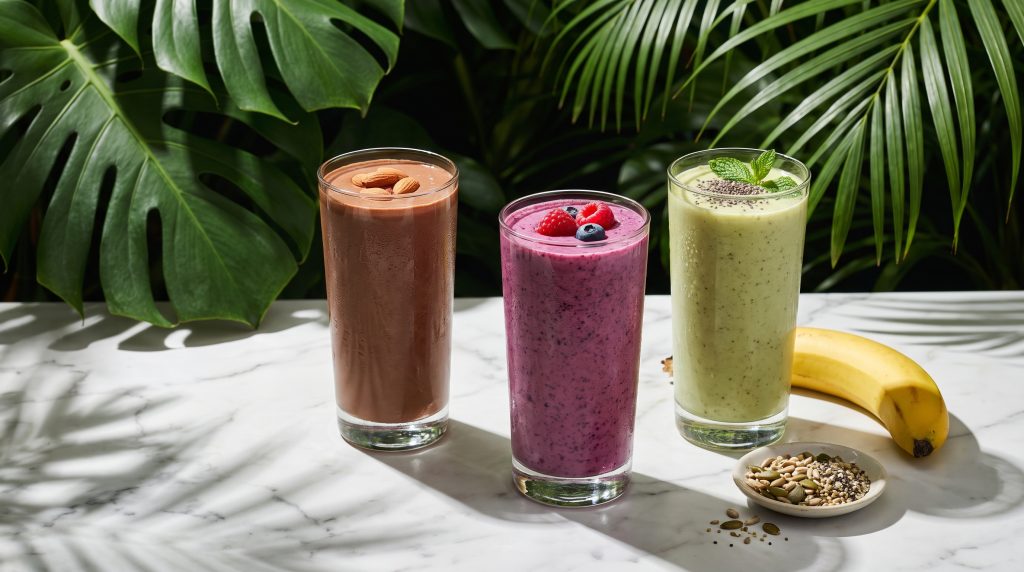
Getting 20–25g of protein from a vegan smoothie is straightforward once you know which ingredients to reach for. Pea protein, hemp protein, silken tofu and nut butter all work well — each with a slightly different flavour profile and texture. Here are four recipes worth making, with honest nutrition numbers for each.
The challenge with vegan protein smoothies
Whole fruit is mostly carbohydrates and water. Oat milk and coconut milk add flavour and body, but relatively little protein. If you’re making a vegan smoothie from fruit and plant-based milk alone, you’re probably looking at 3–6g of protein per serving — useful, but not a post-workout meal.
To push that number to 20g or above, you need to bring in concentrated protein sources. The good news is that several of them blend beautifully, don’t dominate the flavour, and are widely available in the UK.
Vegan protein sources for smoothies
Pea protein powder
The most protein-dense option: approximately 20–22g of protein per 30g serving. It has a neutral flavour (particularly vanilla varieties) and blends smoothly with fruit and plant-based milks. It’s derived from yellow split peas, naturally gluten-free, and well-tolerated by most people.
One note on amino acid profile: unlike whey, pea protein is slightly lower in methionine. This isn’t a practical problem for most people — you’ll get the missing amino acids from the rest of your diet — but it’s worth knowing if you’re relying heavily on a single protein source.
Hemp protein powder
Hemp protein provides roughly 10–15g of protein per 30g serving — less dense than pea, but it brings omega-3 fatty acids, fibre, and a slightly earthy, nutty flavour. That earthiness works well in green smoothies and blends that include banana or oats. Less well in tropical or berry smoothies where the flavour can feel incongruous.
Silken tofu
An ingredient that surprises most people the first time they use it. Silken tofu has a neutral flavour and a texture that adds genuine creaminess to a smoothie — comparable to Greek yoghurt in a non-vegan recipe. Around 6–8g of protein per 100g. It won’t take a single ingredient to 25g on its own, but it works well combined with pea protein or as the primary protein source in a lighter smoothie. Refrigerate leftover silken tofu and use within two days.
Nut butter
Almond butter and peanut butter each provide roughly 7–8g of protein per 30g, alongside healthy fats and flavour. Not protein-dense enough to hit high targets alone, but an excellent supporting ingredient — and it improves texture and satiety considerably.
Oats (whole rolled oats)
Oats are not a concentrated protein source (roughly 5g per 40g serving), but combined with other ingredients they make a meaningful contribution. More importantly, oats add beta-glucan fibre, slow-release carbohydrates, and a thickness that makes a smoothie feel more like a meal.
Four vegan protein smoothie recipes
1. Pea protein and berry smoothie
The classic: frozen berries provide flavour and antioxidants; pea protein does the heavy lifting on the protein count; chia seeds add fibre and omega-3s.
Recipe card
– Prep: 5 min / Total: 5 min / Serves: 1
– Ingredients:
– 150g (1 cup) frozen mixed berries (strawberry, blueberry, raspberry)
– 1 scoop (30g) vanilla pea protein powder
– 200ml (¾ cup) oat milk
– 1 tbsp ground flaxseed
– Steps:
1. Add berries and oat milk to blender.
2. Add pea protein powder and flaxseed.
3. Blend on high for 60 seconds — frozen berries need slightly longer than fresh fruit.
4. Taste. The vanilla protein usually provides enough sweetness; add agave only if needed.
5. Serve immediately.
– Nutrition (approx): ~310 kcal, 33g carbs (of which ~22g natural sugars), 24g protein, 8g fat, 8g fibre
For more berry variations, see our blueberry smoothie recipe.
2. Hemp protein, mango and coconut smoothie
Hemp’s earthy flavour can be tricky in some smoothies, but mango and coconut handle it well — the tropical sweetness and fat from the coconut milk round out the earthiness into something almost nutty.
Recipe card
– Prep: 5 min / Total: 5 min / Serves: 1
– Ingredients:
– 200g (1⅓ cups) frozen mango chunks
– 1 scoop (30g) hemp protein powder
– 200ml (¾ cup) coconut milk (from carton)
– 1 small banana
– Steps:
1. Add mango, banana and coconut milk to blender.
2. Add hemp protein.
3. Blend on high for 60 seconds.
4. If the smoothie is very thick, add a splash more coconut milk.
5. Serve over ice.
– Nutrition (approx): ~320 kcal, 52g carbs (of which ~38g natural sugars), 15g protein, 7g fat, 7g fibre
Note: hemp protein gives you roughly half the protein of pea protein per serving. If you’re targeting 20g+, add a tablespoon of almond butter or a small portion of silken tofu.
For more mango smoothie ideas, see our mango smoothie guide.
3. Silken tofu and banana vanilla smoothie
This one tends to surprise people. Silken tofu disappears completely into a banana smoothie — no tofu taste, no chalky texture, just an unusually creamy, almost milkshake-like consistency.
Recipe card
– Prep: 5 min / Total: 5 min / Serves: 1
– Ingredients:
– 100g silken tofu (chilled)
– 1 large banana
– 200ml (¾ cup) almond milk (unsweetened)
– 1 tsp vanilla extract
– 1 tsp maple syrup (optional)
– Steps:
1. Add silken tofu and almond milk to blender.
2. Blend briefly — 10 seconds — to break up the tofu.
3. Add banana, vanilla and maple syrup if using.
4. Blend on high for 45 seconds until very smooth and creamy.
5. Serve immediately or refrigerate for up to a few hours.
– Nutrition (approx): ~250 kcal, 38g carbs, 10g protein, 5g fat, 4g fibre
Tip: for a higher protein version, add one scoop of vanilla pea protein as well — you’ll push the protein up to approximately 30g while keeping the vanilla-banana flavour profile intact.
4. Oat and peanut butter protein smoothie
No protein powder required here. Oats, peanut butter and oat milk each contribute a modest amount of protein; combined, they add up. This is the most substantial smoothie of the four — close to a meal in texture and calorie count.
Recipe card
– Prep: 5 min (plus overnight if soaking oats) / Total: 5 min / Serves: 1
– Ingredients:
– 40g (½ cup) rolled oats (soaking overnight in a little oat milk is optional but improves texture)
– 2 tbsp peanut butter
– 1 large banana
– 250ml (1 cup) oat milk
– ½ tsp cinnamon
– Steps:
1. If soaking oats, drain and add to blender. If not, add dry oats — blend for 30 seconds first before adding other ingredients.
2. Add banana, peanut butter, oat milk and cinnamon.
3. Blend on high for 60 seconds.
4. If too thick, add more oat milk. This one is meant to be thick.
5. Serve immediately.
– Nutrition (approx): ~480 kcal, 62g carbs, 17g protein, 18g fat, 8g fibre
Note: this smoothie is more calorie-dense than the others. It works well as a breakfast or post-gym meal replacement, less so as a light snack.
Tips for better vegan protein smoothies
Blend protein powder with liquid before adding frozen fruit. Adding pea protein directly to a blender full of frozen fruit can cause it to clump. A quick 5-second blend with the liquid first prevents this.
Silken tofu keeps for 2–3 days in the fridge once opened. Stir it into other smoothies through the week rather than letting it go to waste.
Don’t mistake “vegan” for “lower calorie”. Nut butter, coconut milk and oats are calorie-dense ingredients. This isn’t a problem — these are nutritious calories — but it’s worth being aware of portion size if you’re also watching overall intake.
Frozen fruit is your friend. It thickens the smoothie, keeps it cold, and is usually more nutritious than fresh fruit that’s been sitting in a supermarket for a week.
Framberry’s vegan smoothies
Everything on Framberry’s smoothie menu is vegan. We use pea protein and hemp protein as our booster options, so you can add either to any fruit base. All our smoothies are halal-friendly and kosher-friendly.
We’re opening in London in 2027. Join the list to get early access.
Frequently asked questions
How do I get 25g of protein in a vegan smoothie without it tasting of protein powder?
Use a good quality vanilla pea protein (brands vary significantly — it’s worth trying a few) alongside naturally sweet fruit like banana or mango. The fruit’s sugar masks most of the protein powder flavour. Silken tofu also contributes protein without any distinctive taste. See our protein smoothie guide for more combinations.
Is pea protein better than hemp protein for smoothies?
Pea protein is more protein-dense (~21g per 30g versus ~12g for hemp) and more neutral in flavour. Hemp protein brings omega-3s, fibre and a nuttier taste. Neither is universally “better” — choose based on what you’re prioritising. Many people use pea protein as their main source and hemp protein occasionally for variety.
Can I make a vegan protein smoothie without any protein powder?
Yes, though it takes a bit more effort. Silken tofu (8g/100g), peanut butter (8g/30g), oats (5g/40g) and hemp seeds (5g/15g) can collectively push a smoothie to 15–20g of protein. You’ll need generous portions of several of these to hit the higher range.
Is silken tofu suitable for all dietary requirements?
Silken tofu is vegan, gluten-free, and dairy-free. It contains soy, which is one of the 14 major allergens in the UK, so it’s not suitable for anyone with a soy allergy.
Are Framberry’s smoothies vegan?
Yes — all Framberry smoothies are vegan, halal-friendly, and kosher-friendly.
All Framberry smoothies are vegan, and every one can be built to your specification — protein booster included. Opening in London in 2027. Join the list.