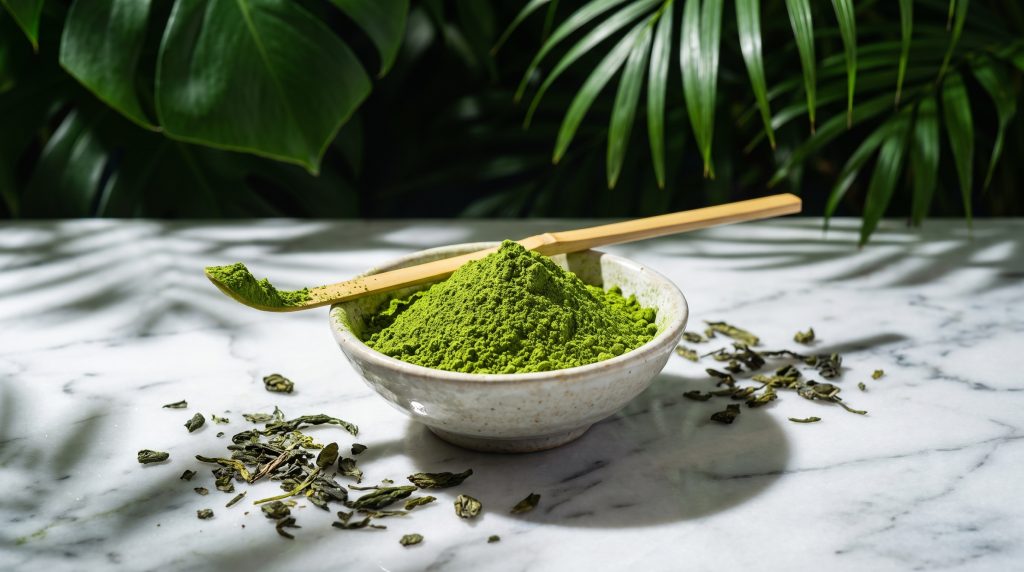
Matcha is powdered green tea made from the leaves of Camellia sinensis — the same plant that gives us green tea, black tea, and white tea. What makes it different is how those leaves are grown and processed: shaded for weeks, hand-picked at peak quality, then stone-ground into a fine bright-green powder you whisk directly into water or milk.
Definition box
Matcha is a type of powdered green tea made from shade-grown Camellia sinensis leaves that are stone-ground whole. Unlike steeped green tea, where you discard the leaves after brewing, with matcha you consume the entire leaf — which is why the flavour, colour, and nutritional profile are so concentrated.
The plant: Camellia sinensis
Every cup of matcha starts with the same plant that produces all true teas: Camellia sinensis. The difference between a green tea bag and a tin of ceremonial matcha comes down entirely to how the plant is farmed and how the leaves are handled afterwards.
Matcha is grown primarily in Japan — with the Uji region of Kyoto and Nishio in Aichi prefecture considered the gold-standard growing areas. The climate, soil, and generations of farming knowledge in these regions produce leaves with a flavour profile and colour that other regions have struggled to replicate at scale.
Shade-growing: the step that changes everything
About three to four weeks before harvest, matcha farmers cover the plants — traditionally with straw or bamboo screens, now often with synthetic shade cloth — blocking out roughly 90% of sunlight. This deliberate deprivation triggers two important changes in the plant.
First, the plant ramps up chlorophyll production, the pigment it uses to capture what little light remains. That’s where matcha’s vivid green colour comes from. Second, the leaves accumulate L-theanine, an amino acid that stays trapped in the leaf rather than converting into bitter catechins, as it would under full sun. The result is a leaf that is sweeter, more umami-rich, and less aggressively bitter than unshaded green tea.
Stone-grinding: why it takes so long
After harvest, the leaves go through steaming, drying, and de-stemming to produce a product called tencha — essentially the dried leaf material ready for grinding. That tencha is then fed slowly through granite millstones, which grind it into the fine, silky powder you spoon into your cup.
It is a slow process. A single stone mill produces roughly 10 grams of matcha powder per hour. That is why quality matcha is expensive and why corners cut at this stage — using high-speed industrial grinders that generate heat and degrade flavour — produce an inferior result.
What is actually inside a cup of matcha?
When you whisk matcha into water, you are suspending ground leaf particles throughout the liquid. That means everything in the leaf ends up in your cup. Here is what you are actually drinking:
Caffeine
A typical 2g serving of matcha contains roughly 38–70mg of caffeine, depending on grade, growing conditions, and preparation. That puts it somewhere between a cup of green tea and a shot of espresso. The caffeine in matcha tends to feel less spiky than coffee for many people — which brings us to the next compound.
L-theanine
L-theanine is an amino acid found almost exclusively in the tea plant. It is present in all teas, but particularly concentrated in shade-grown matcha because the shading process prevents it from converting into other compounds. Some studies suggest that L-theanine may moderate the more jittery effects of caffeine and support a state of calm alertness, though research is still ongoing. A 2g serving of matcha contains approximately 17–26mg of L-theanine.
EGCG — the main antioxidant catechin
Epigallocatechin gallate, usually abbreviated to EGCG, is the primary catechin antioxidant in matcha. Because you are consuming the whole leaf rather than an infusion of it, matcha delivers significantly more EGCG per serving than a cup of green tea brewed from loose leaves or a bag. Research into EGCG is active and interesting, though the NHS and EFSA both recommend measured language around its benefits — more on that in our guide to whether matcha is good for you.
Chlorophyll
Chlorophyll is the pigment responsible for matcha’s distinctive colour, and it arrives in abundance thanks to the shade-growing process. It is also the reason matcha stains — chlorophyll produces a yellow-green stain that can be stubborn on fabric and equipment if not rinsed immediately.
Vitamins and minerals
Matcha is a source of vitamin C, vitamin A (in the form of beta-carotene), vitamin K, and B vitamins, along with minerals including potassium, calcium, and magnesium. The amounts per serving are relatively modest, but they arrive alongside everything else in the leaf rather than in isolation.
Ceremonial grade vs culinary grade: what’s the difference?
Not all matcha is made equal. The grade system is informal and unregulated, but the two broad categories are:
| Ceremonial grade | Culinary grade | |
|---|---|---|
| Harvest | First flush (youngest leaves) | Later harvest |
| Colour | Vivid, bright green | Duller, more yellow-green |
| Flavour | Umami, mildly sweet, smooth | More bitter, grassier |
| Best use | Drinking — straight or as a latte | Baking, smoothies, cooking |
| Price | Higher | Lower |
Ceremonial grade matters when matcha is the main event — when you are drinking it as a latte or whisking it into hot water and tasting every note. Culinary grade is perfectly suited to recipes where other flavours are doing the heavy lifting.
What grade does Framberry use?
At Framberry, we use ceremonial-grade Japanese matcha across our entire matcha menu. That means you get the real thing: vivid colour, smooth umami flavour, and leaves processed to the standard where the powder alone tastes good. We will be opening in London in 2027 — you can join the interest list at our locations page.
If you want to explore everything we know about this ingredient, our full matcha guide covers sourcing, preparation, and the science in depth.
Frequently asked questions
Is matcha just green tea?
Matcha comes from the same plant as green tea, but it is made differently. Green tea is typically steeped and the leaves discarded; matcha leaves are shaded before harvest, then stone-ground into a powder that you whisk whole into your drink. You consume the entire leaf, which makes the flavour and compound concentrations quite different.
Does matcha contain caffeine?
Yes. A typical 2g serving contains roughly 38–70mg of caffeine — more than a cup of green tea, but usually less than a standard shot of espresso. The presence of L-theanine means many people find the alertness it produces feels smoother than coffee, though individual responses vary.
What makes matcha green?
The vivid green colour comes from chlorophyll, which the plant produces in abundance during the shading period before harvest. High-quality ceremonial-grade matcha has a brighter, more saturated green; duller, yellower-green powder is a sign of lower grade or older matcha that has begun to oxidise.
Is matcha vegan?
Plain matcha powder is vegan. Whether your finished drink is vegan depends on what you mix it with — oat or coconut milk make it vegan, dairy milk does not. At Framberry, oat and coconut milk are our standard choices.
Why does matcha sometimes taste bitter?
Bitterness in matcha usually comes down to grade and temperature. Culinary-grade matcha has more bitter catechins than ceremonial grade. Water that is too hot (above around 80°C) can also emphasise bitterness. Good-quality ceremonial-grade matcha whisked with water at 80°C should taste smooth and pleasantly umami.
Curious what ceremonial-grade matcha actually tastes like? We’re opening in London in 2027 — join the interest list and be the first to know when we’re ready for you.