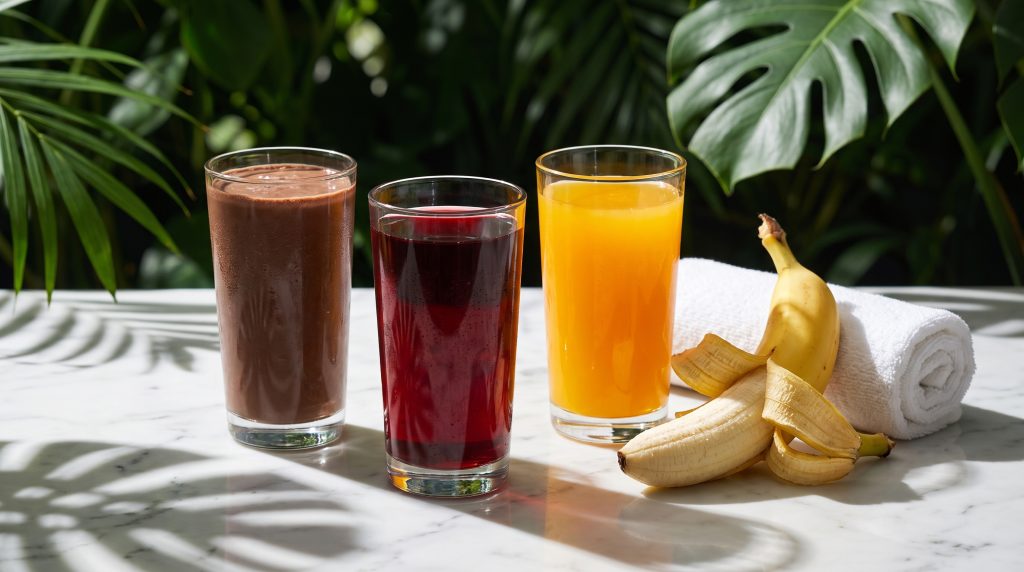
The protein shake has dominated post-workout culture for decades. It’s not wrong — protein is genuinely important for recovery — but it’s also not the whole picture. Depending on what you’ve just done, when you last ate, and what your body needs, there are several drinks worth considering. Some are surprisingly well-supported by research; others are trendier than they are useful. Here’s an honest rundown.
Why what you drink after exercise matters
Exercise — especially resistance training, long runs or intense interval sessions — creates a state where your muscles are primed to absorb nutrients. You’ve used up glycogen (stored carbohydrate energy), you’ve created small amounts of muscle damage that the body will repair and strengthen, and you’ve lost fluid through sweat.
The drinks that serve you best post-workout address some or all of the following:
– Rehydration — replacing lost fluid (and electrolytes if you’ve sweated heavily)
– Carbohydrates — restoring energy stores
– Protein — supporting muscle repair and adaptation
Not every session needs a full recovery stack. A gentle 30-minute yoga flow needs water and maybe a snack. A two-hour long run or a tough weights session is a different matter entirely.
1. Water — the non-negotiable baseline
Every other drink on this list is a bonus. Water is the foundation. Rehydrating with plain water is the first priority after any workout, full stop.
If you’ve exercised for under an hour in comfortable temperatures, plain water alongside a balanced meal or snack will cover most of your needs. Nothing fancy required. For longer or more intense sessions, keep reading.
2. Protein smoothies — the closest thing to an all-rounder
A well-made protein smoothie is genuinely hard to beat as a post-workout drink. Done properly, it delivers carbohydrates (from fruit and milk), protein (from powder or natural sources), fluid and often some useful micronutrients too.
Research suggests that consuming roughly 20–40g of protein in the couple of hours after resistance or endurance exercise may support muscle protein synthesis — the process your body uses to repair and rebuild muscle tissue. A banana-and-protein smoothie is one of the most enjoyable ways to hit that target.
Our post-workout smoothie recipe uses:
– Frozen banana (carbs, potassium)
– Oat milk (carbs, gentle protein)
– Vanilla protein powder (~25g protein)
– Peanut butter (fat, extra protein)
– Chia seeds (omega-3s, fibre)
That’s roughly 400 kcal, 45g carbs and 30g protein — a solid recovery combination in one glass.
See the smoothies menu to find what Framberry offers when we open.
3. Matcha lattes — calm energy and antioxidants
Matcha isn’t the obvious post-workout choice, but it’s become a genuine favourite among the yoga and Pilates crowd — and there’s good reason for it.
Ceremonial-grade matcha contains roughly 38–70mg of caffeine per serving, combined with L-theanine, an amino acid that some research suggests may moderate the jitteriness associated with caffeine alone. If your post-workout window involves sitting down to work or get on with your day, a matcha latte offers steadier, calmer energy than a double espresso.
Matcha also contains EGCG (epigallocatechin gallate), a type of antioxidant. Some early research has explored potential roles for antioxidants in exercise recovery, though this area is still developing and we wouldn’t make strong claims here.
As a drink, a matcha latte with oat milk also contributes to rehydration and, if made with a milk alternative containing some protein, adds a small protein boost. It’s not a protein shake. But as a post-workout ritual that’s warm, calming and genuinely enjoyable, it holds its own.
Read more in our matcha pre-workout guide — many of the same properties apply on the way out of the gym too.
4. Coconut water — natural electrolytes, real benefits
Coconut water has earned its reputation as a post-workout drink, even if the marketing sometimes runs ahead of the evidence.
What it genuinely offers:
– Potassium — one of the key electrolytes lost in sweat
– Some natural sodium and magnesium — though sodium content is lower than in dedicated sports drinks
– Natural carbohydrates — modest amounts, which can help with glycogen replenishment
– Good hydration — as an alternative to plain water, it’s a pleasant and effective choice
The honest caveat: for very heavy sweating (think marathon-distance running in summer heat), coconut water’s sodium content may not be sufficient on its own. Commercial electrolyte products or sodium-containing foods alongside coconut water may be needed in those cases. For most gym sessions or casual runs, coconut water is a genuinely useful drink.
5. Chocolate milk — surprisingly well-supported
Chocolate milk is one of those post-workout recommendations that sounds like it was invented to please children but turns out to have real research behind it.
The carbohydrate-to-protein ratio in chocolate milk (roughly 3–4:1) happens to align well with what sports nutritionists often recommend for recovery after endurance exercise. Several studies have found it to be an effective recovery drink compared with sports drinks and even some protein shakes. It also provides calcium, fluid and some sodium.
The caveats worth noting: most studies have been relatively small; many used chocolate milk provided by the dairy industry; and the specific carb-to-protein ratio matters more than the chocolate milk per se — other drinks can achieve similar ratios. That said, it’s a legitimate, well-studied option and an accessible one. If you like it, there’s no reason not to reach for it.
For a dairy-free version, a oat milk smoothie with banana and protein powder achieves something similar nutritionally.
6. Tart cherry juice — interesting research, early days
Tart cherry juice has attracted real scientific attention as a recovery drink, with some studies suggesting it may help reduce muscle soreness and inflammation markers after intense exercise. A number of these studies were conducted with athletes doing long-distance running or resistance training.
The honest appraisal: most studies are small, the effects are modest, and tart cherry juice is genuinely tart (acquired taste territory). It’s not going to transform your recovery, but if you enjoy it and already drink juice, it’s one of the more interesting options from a research perspective. Look for unsweetened versions.
7. Oat milk drinks — underrated for recovery
Oat milk is increasingly the default for London’s coffee bars, and for good reason beyond sustainability and taste. A large oat milk latte or a cold brew with oat milk provides:
– Carbohydrates (from the oats — useful post-workout)
– Some protein (oat milk typically contains 1–2g per 100ml)
– A genuinely enjoyable drink
It’s not a protein shake, and it shouldn’t be positioned as one. But as a liquid that contributes to recovery while also being something you actually want to drink, it’s solid. Framberry uses oat milk as standard across the coffee menu.
The honest summary
If you want to cover most post-workout recovery bases in one drink, a banana and protein smoothie is genuinely hard to beat. It’s practical, evidence-backed, adaptable to vegan and dairy-free diets, and — if made well — actually delicious.
Beyond that:
– Matcha latte if you want calm, sustained energy and a more ritual-like post-workout moment
– Coconut water if electrolytes are a priority and you prefer something light
– Chocolate milk if you’re okay with dairy and want a fuss-free carb-protein combination
– Water always, as the foundation everything else builds on
What you don’t need: a complicated stack of supplements, powders and shots. Real ingredients, in sensible combinations, do the job.
Explore the best post-workout drinks in more depth via our wellness drinks guide, or see what to eat and drink specifically after a run.
Frequently asked questions
Should I drink a protein shake immediately after training?
The “anabolic window” — the idea that you must consume protein within 30 minutes or miss out — is somewhat overstated. Research suggests you have a couple of hours after exercise to get protein in and still support recovery effectively. Do aim for the same day; the exact minute matters less.
Is a banana enough after a light gym session?
Alongside water, yes — a banana is a convenient source of carbohydrates and potassium that supports recovery after a light session. For heavier sessions, pair it with a source of protein.
Are energy drinks okay post-workout?
Most commercial energy drinks are high in caffeine and sugar, low in useful nutrients, and not designed for recovery. They’re not the worst thing in the world, but they’re not the best either. A matcha latte or a coffee with oat milk gives you caffeine without the same sugar load.
What’s the best post-workout drink for weight loss?
There’s no single drink that specifically promotes weight loss. Post-workout, your priority is recovery — adequate protein and carbohydrates within a couple of hours. Avoiding very high-calorie, high-sugar drinks is sensible, but don’t skip carbs entirely after exercise; it can leave you depleted and overeating later.
Does matcha count as a recovery drink?
Not in the traditional sports-science sense — it’s not a protein source and it won’t replenish glycogen on its own. But it provides caffeine for sustained energy, L-theanine for calm focus, and the liquid contributes to rehydration. As part of a broader post-workout routine (alongside water and food), it’s a great choice.
Framberry is opening in London in 2027 as a post-workout clubhouse for the run club, yoga class, and gym crowd. Everything on the menu is non-alcoholic, oat milk is the default, and every smoothie takes a protein boost. Join the list to hear when we open.