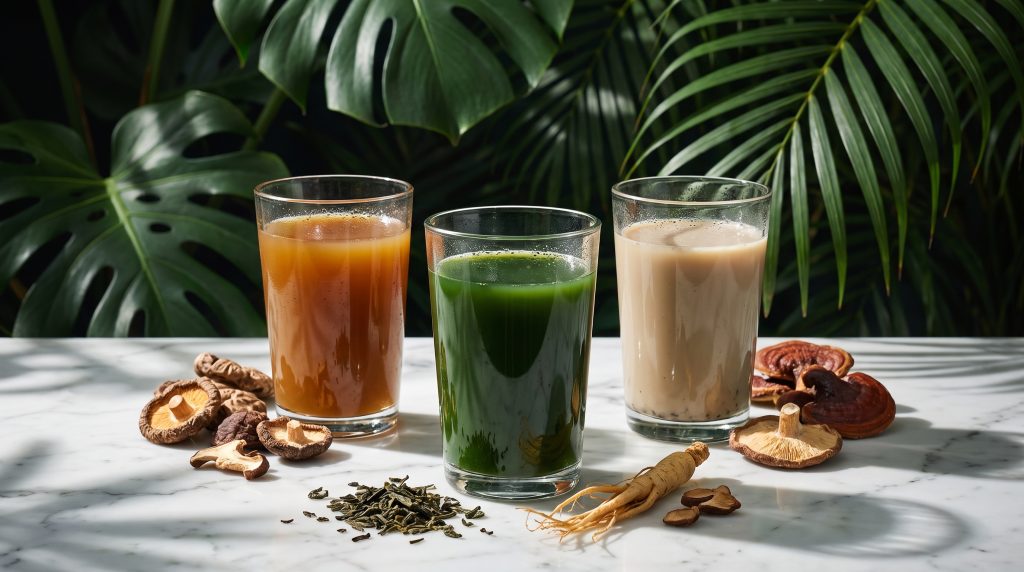
Functional drinks are everywhere. Every second product in a health food shop claims to reduce stress, sharpen focus, boost energy and improve your sleep — sometimes simultaneously, in a 250ml can. The category is growing fast, the marketing is often spectacular, and the science is, let’s say, mixed.
Here’s a clear-eyed look at what functional drinks actually are, which ingredients have decent evidence behind them, which are more hype than substance, and how to think about this when choosing what to drink.
What is a functional drink?
A functional drink is any beverage formulated to provide a benefit beyond basic hydration and nutrition. That might mean cognitive support, stress resilience, improved focus, better sleep or exercise recovery.
The category includes:
– Adaptogen drinks (ashwagandha, rhodiola, maca)
– Nootropic drinks (caffeine, L-theanine, lion’s mane)
– Kombucha and fermented drinks
– Electrolyte drinks
– Protein and recovery drinks
Some of these have solid evidence behind them. Others are extrapolated from traditional medicine or very early-stage research. And a few are marketing labels more than anything scientifically meaningful. Let’s go through the main ones.
Adaptogens: what they are and where the evidence stands
Adaptogens are plant-derived substances that are believed to help the body adapt to stress — physical, mental or environmental. The concept comes from traditional herbal medicine; the modern term was coined in Soviet sports science in the mid-20th century.
The most common adaptogens you’ll encounter in drinks:
Ashwagandha
Ashwagandha (Withania somnifera) is probably the most extensively studied adaptogen. Some human trials have found it may help reduce perceived stress and anxiety, improve sleep quality and support exercise recovery. Most studies are relatively small, and dosages vary considerably across products.
Honest appraisal: the evidence is more developed than for most adaptogens, but still developing. If a product contains a meaningful dose of a standardised extract (typically 300–600mg), there’s some basis for its stress-support claims. If it contains a trace amount, it’s probably there for the label.
Rhodiola rosea
Rhodiola has been studied in the context of fatigue and mental performance, particularly in high-stress situations. Some studies suggest it may help reduce fatigue and improve concentration. Research quality varies, and effect sizes are generally modest.
Honest appraisal: an interesting ingredient with a reasonable body of evidence, but not a miracle. Worth taking seriously in a product that uses meaningful quantities.
Maca
Maca is a Peruvian root vegetable. It’s found in smoothies, powders and drinks, often marketed for energy and libido. Human research is limited; most evidence is either animal-based or derived from very small human trials.
Honest appraisal: less evidence than ashwagandha or rhodiola for the specific claims often made. It’s nutritious as a food, but the functional claims should be taken with some scepticism.
Nootropics: substances thought to support cognitive function
Nootropics are substances believed to enhance memory, focus, creativity or motivation. The evidence base varies enormously.
Caffeine — the best-evidenced nootropic
Caffeine is, without question, the most well-researched cognitive enhancer available. It works by blocking adenosine receptors in the brain, reducing feelings of fatigue and improving alertness and concentration. Its effects are well-documented across hundreds of controlled studies.
It also comes with known downsides: jitteriness, increased heart rate, disrupted sleep if consumed too late in the day, and dependency if used regularly. These are well-understood and manageable; they don’t make caffeine problematic for most healthy adults.
L-theanine — best in combination with caffeine
L-theanine is an amino acid found naturally in tea leaves and, notably, in ceremonial-grade matcha. On its own, it has mild relaxing effects. Combined with caffeine, some studies suggest the pairing may support sustained, focused attention with reduced jitteriness compared to caffeine alone.
This is one of the better-evidenced functional combinations in the drinks world. It’s not dramatic in effect, but the research is reasonably consistent and the mechanism is understood.
This is one reason why matcha sits in a different category to standard energy drinks — it naturally contains both caffeine and L-theanine in a meaningful ratio. See our matcha guide for more on this.
Lion’s mane mushroom
Lion’s mane (Hericium erinaceus) is a mushroom extract increasingly added to coffees, teas and functional drinks. Some early research suggests it may support nerve growth factor production and has been explored in the context of cognitive health.
Honest appraisal: early-stage research, mostly in animal models or very small human studies. Some of the human trials show promising signals, but the evidence is not yet robust enough to make confident claims. If it’s in a product, it’s not unreasonable — but don’t expect transformative effects.
Hype versus reality: how to read functional drink claims
A few useful filters when evaluating a functional drink:
Does the ingredient have human evidence? Animal studies and petri dish results are interesting but don’t translate directly to human effects. Look for controlled human trials.
Is the dose meaningful? Many products include adaptogenic or nootropic ingredients at doses far below those used in studies. “Contains ashwagandha” can mean 500mg of a studied extract or 5mg of a passing mention.
What does “may support” actually mean? Reputable products use careful language: “may support”, “some studies suggest”. If a drink claims to cure, prevent or detox, that’s a red flag regardless of the ingredient.
Is it replacing something, or adding to it? A functional drink that replaces a high-sugar energy drink is probably a step forward. A functional drink added to a balanced, healthy lifestyle is a small bonus at best.
Framberry’s approach: real ingredients, honest claims
At Framberry, we’ve built the menu around ingredients with genuine credibility. Matcha is the centrepiece — ceremonial-grade, with naturally occurring caffeine and L-theanine in a combination that’s well-studied. Fruit smoothies provide real nutrition. Protein and superfood boosters are available where they make sense.
We won’t put ashwagandha in a drink and tell you it will eliminate stress. We won’t add a sprinkle of lion’s mane and claim it’ll sharpen your cognition. What we will do is offer drinks made from real ingredients, where any functional benefit is backed by at least a credible body of research — and where we use careful, honest language about what those benefits might be.
Functional drinks can be a genuinely interesting addition to a well-rounded routine. They’re not a substitute for sleep, food, movement and social connection. But a well-made matcha latte, with its naturally balanced caffeine and L-theanine, is about as good a functional drink as you’ll find anywhere.
Explore the wellness drinks guide for more, or see how matcha compares to coffee in our matcha vs coffee piece.
Frequently asked questions
Are functional drinks safe?
Most functional drinks on the market are safe for healthy adults. Some adaptogen ingredients interact with medications (ashwagandha, for example, may affect thyroid hormone levels), and high-caffeine functional drinks can cause problems for caffeine-sensitive people. If you have a health condition or take medication, it’s worth checking with a GP before adding new supplements.
Is matcha a functional drink?
Matcha fits the definition well — it’s a drink consumed partly for its functional properties (caffeine for alertness, L-theanine for calm focus) rather than purely for nutrition or taste. Unusually for the functional drink category, its key active ingredients are well-studied.
Do adaptogens actually work?
Some do, for some people, in the right doses. Ashwagandha has the most robust human evidence for stress and anxiety support. Rhodiola has decent evidence for fatigue reduction. Maca and many others have thinner evidence. No adaptogen is a replacement for addressing the root causes of stress.
What’s the difference between a nootropic and an adaptogen?
Adaptogens are specifically associated with stress resilience and helping the body adapt to physical or mental pressure. Nootropics are more broadly associated with cognitive function — focus, memory, alertness. There’s overlap: some substances (like ashwagandha) might reasonably be called both.
Are energy drinks functional drinks?
Some energy drinks market themselves as functional, and caffeine is a well-evidenced nootropic. But most mainstream energy drinks rely heavily on large doses of caffeine and sugar, with other ingredients present in quantities too small to have meaningful effects. Calling a high-sugar, high-caffeine drink “functional” is technically accurate but somewhat misleading in spirit.
Framberry is opening in London in 2027. Ceremonial-grade matcha, real-fruit smoothies, and honest ingredients — no overclaiming, no wellness theatre. Join the list.