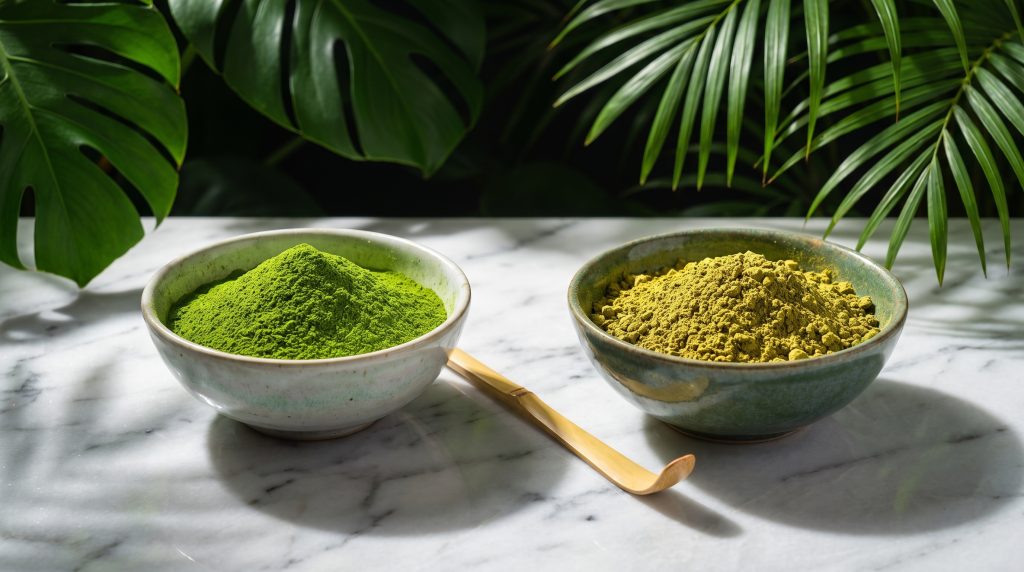
Ceremonial-grade matcha is made from the youngest, first-harvest tea leaves, shade-grown and stone-ground into a fine, bright green powder. It’s sweeter, smoother, and best for drinking as-is — whisked with water or made into a latte. Culinary-grade matcha uses later-harvest leaves, tastes more bitter, and is designed for baking and cooking rather than drinking straight.
Where the difference begins: the harvest
All matcha starts as Camellia sinensis — the same plant used for every type of tea. What distinguishes ceremonial from culinary grade begins several weeks before harvest and continues through every step of processing.
Three to four weeks before picking, ceremonial-grade tea plants are covered, blocking most of the sunlight. This shade-growing process triggers the plant to produce more chlorophyll — giving the leaves their vivid, saturated green — and more L-theanine, an amino acid associated with the characteristic umami sweetness of high-quality matcha. The plant slows its growth, concentrating flavour into the youngest leaves.
At harvest, only the most tender, youngest leaf tips are hand-picked. This first flush of leaves is the finest the plant produces. It’s what goes into ceremonial-grade matcha.
Culinary-grade matcha uses leaves from later harvests — sometimes the second or third flush — as well as older, larger leaves from the same plant. These leaves have had more exposure to sunlight, contain less L-theanine, and are less sweet. They also tend to have a stronger, more bitter flavour.
After harvesting, the process for both grades involves steaming, drying, and removing stems and veins to produce “tencha” — the raw material for matcha. Both grades are then stone-ground. The difference is in the quality of the tencha, not the grinding process.
What does each grade taste like?
Ceremonial grade is notably sweeter and less bitter than culinary grade. High-quality ceremonial matcha has a creamy, umami character with a clean vegetal flavour and minimal bitterness, even when prepared simply with water. The colour is vivid — a bright, saturated green. The texture when sifted is extremely fine, almost silky.
Culinary grade has a more pronounced bitterness and a less nuanced flavour. This isn’t a defect in context — the bitterness holds up well when other flavours are present. Baked into a cake, blended into a smoothie with banana and oat milk, or incorporated into a sauce, culinary-grade matcha performs well. You’d struggle to detect the bitterness amid a moist, sweet matcha muffin. Drink it plain with just water, though, and the harshness becomes apparent.
How to tell them apart at a glance
| Ceremonial grade | Culinary grade | |
|---|---|---|
| Harvest | First flush (youngest leaves) | Later flushes (older leaves) |
| Shade-growing | 3–4 weeks, intensive | Less or none |
| Colour | Vivid, bright green | Duller, more olive or yellow-green |
| Taste | Sweet, umami, smooth | More bitter, stronger, sharper |
| Texture | Very fine, silky | Fine but sometimes coarser |
| Typical price | £20–50 per 30g | £5–15 per 30g |
| Best for | Drinking straight, lattes | Baking, smoothies, cooking |
| Framberry uses? | Yes | No |
Price: why is ceremonial grade so expensive?
The price difference is significant — ceremonial matcha typically costs three to five times more per gram than culinary grade — and the reasons are genuine, not marketing.
Hand-harvesting young leaves is labour-intensive. The shade-growing process requires infrastructure and management. Stone-grinding is slow — a single mill can produce only 30–40g per hour. First-harvest ceremonial leaves yield less volume than later-harvest culinary leaves. The packaging needs to be airtight and opaque to prevent oxidation. All of this adds up.
When you pay £30 for 30g of ceremonial matcha, you’re paying for months of careful cultivation, skilled labour, and a production rate of less than a kilogram per mill per day. That context makes the price feel less arbitrary.
Does grade matter for lattes?
Yes. This is worth being direct about, because some cafés and recipes suggest that any matcha is interchangeable in a latte.
In a matcha latte, the powder is the entire flavour. There’s nothing else hiding behind it except the milk. Culinary-grade matcha in a latte will taste noticeably more bitter — particularly as the drink cools — and the vibrant green colour will be less pronounced. If you’ve tried a matcha latte and found it harsh or unpleasant, there’s a good chance culinary-grade matcha was the culprit.
Ceremonial-grade matcha in a latte produces a smoother, sweeter, more nuanced result. The flavour is recognisably matcha but without the astringency that culinary grade can produce when it’s the star of the drink rather than a background ingredient.
At Framberry, we use ceremonial-grade Japanese matcha in all our drinks. This is the minimum standard we’d want to drink ourselves, so it’s what we serve.
Regional quality: Japan’s premium matcha regions
Japan produces the majority of the world’s high-quality matcha. Within Japan, two regions are particularly associated with ceremonial-grade production.
Uji, Kyoto is the most historically prestigious matcha region. The microclimate, the soil, and centuries of cultivation experience produce some of the most distinctive and sought-after matcha available. Uji matcha is often regarded as the benchmark against which others are measured.
Nishio, Aichi is the largest matcha-producing region in Japan by volume, producing a significant proportion of the country’s ceremonial and culinary grade powder. Quality can be excellent, and Nishio matcha appears in many of the leading brands available in the UK.
Both regions use the same fundamental shade-growing and stone-grinding methods; the differences come from soil, climate, and producer skill rather than fundamental process.
Which grade should you buy?
Buy ceremonial grade if you’re drinking matcha as a standalone tea, making matcha lattes, or preparing iced matcha at home. The flavour difference is meaningful enough to justify the extra cost.
Buy culinary grade if you’re using it in baking, smoothies, or as one ingredient among many where other flavours will dominate. There’s no point paying ceremonial prices for something that’s going into a cake batter.
For more on making matcha at home with either grade, see how to make matcha without a whisk and our complete matcha guide.
Frequently asked questions
Is ceremonial grade matcha worth the extra cost?
For drinking — yes, clearly. Ceremonial-grade matcha is noticeably sweeter and less bitter, and the colour and texture are superior. For baking or adding to smoothies, culinary grade does the job at a fraction of the price.
What grade does Framberry use?
Ceremonial-grade Japanese matcha. We use it in all our drinks — hot lattes, iced matcha, strawberry matcha — because culinary grade produces a noticeably inferior result when matcha is the main flavour of the drink.
Can you taste the difference between ceremonial and culinary matcha?
Yes, particularly in a simple preparation like matcha whisked with water, or in a latte. Ceremonial grade is sweeter and smoother. Culinary grade is more bitter. The difference is less pronounced in baked goods, which is why culinary grade is fine for cooking.
Is culinary grade matcha bad?
Not at all — it’s simply a different product for a different use. Culinary-grade matcha is entirely appropriate for baking, smoothies, and cooking. It’s only inferior to ceremonial grade when used for drinking straight, where the bitterness becomes noticeable.
Where does the best matcha come from?
Japan dominates high-quality matcha production. Uji in Kyoto and Nishio in Aichi are the two most prominent regions for ceremonial-grade matcha. Chinese and Korean matcha is also produced but is less common in the premium market.
Framberry uses ceremonial-grade Japanese matcha in every drink — because the grade genuinely matters when matcha is the point of the drink. We’re opening in London in 2027. Join the list.