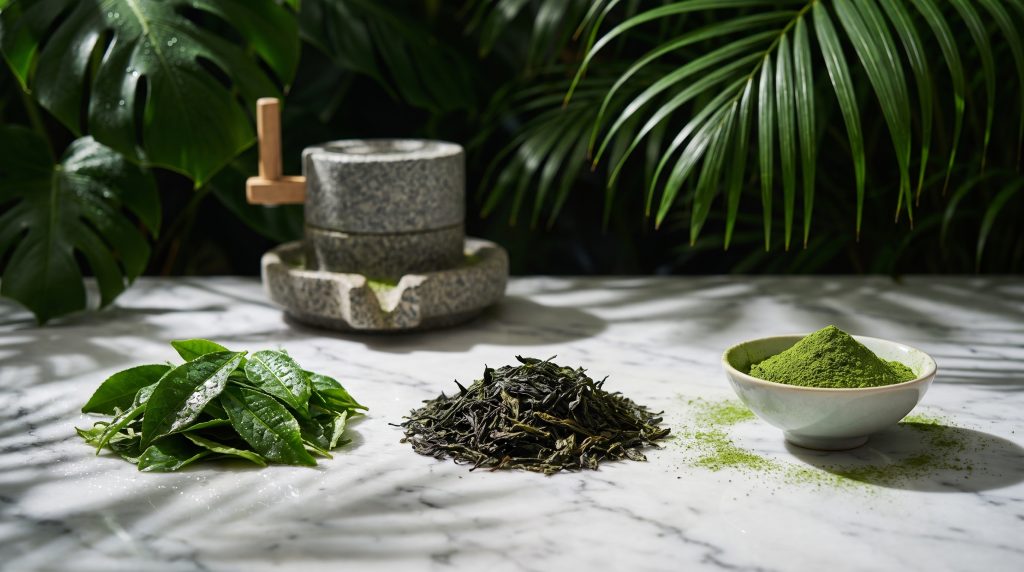
Matcha is made from shade-grown Camellia sinensis leaves that are hand-picked, steamed, dried, de-stemmed, and stone-ground into a fine powder. The process takes weeks of careful farming and, at the grinding stage, roughly one hour to produce just 10 grams of finished powder — which goes a long way towards explaining why the good stuff costs what it does.
Definition box
Matcha is not a separate plant from green tea — it is the same Camellia sinensis plant, grown and processed by a specific method that produces a fine powder you drink whole rather than steep and discard.
Most food production involves a compromise between quality and scale. Matcha is unusual because the steps that make it taste exceptional — the shade-growing, the hand-picking, the stone-grinding — are precisely the steps that resist industrialisation. Understanding how matcha is made tells you a great deal about why it commands a premium and why most of the world’s best matcha still comes from a handful of regions in Japan.
Step 1: Shading the plants (3–4 weeks before harvest)
The first and arguably most important step in making premium matcha does not involve the leaves directly. Around three to four weeks before harvest, farmers cover the tea plants to block out most of the sunlight — typically 70–90% of it.
Traditionally this was done with bamboo and rice straw structures. Modern farms often use synthetic shade cloth. The effect on the plant is significant: deprived of full sunlight, it compensates by producing more chlorophyll (giving matcha its vivid green colour) and accumulating L-theanine, an amino acid that — in full-sun conditions — would convert into bitter catechins. The result is a leaf that is sweeter, more umami-rich, and less bitter than it would otherwise be.
Unshaded green tea (like sencha) is good in its own right, but the shading step is what makes matcha taste like matcha.
Step 2: Harvesting (first flush, hand-picked)
The highest-quality matcha comes from the first flush — the first harvest of the season, typically in early May in Japan. First-flush leaves are the youngest growth on the plant: smaller, more tender, and with the highest concentration of the compounds the shading process has encouraged.
Picking is traditionally done by hand, which allows harvesters to select only the youngest, most suitable leaves. Only the leaf blade goes forward — not the stems, not the older leaves lower down the plant.
Later harvests produce the raw material for culinary-grade matcha. The leaves are older, the catechin levels higher, and the flavour more bitter. Still useful, but not what ends up in your morning latte at a ceremonial-grade café.
Step 3: Steaming (stopping oxidation)
Immediately after harvest, the leaves are steamed briefly — typically for 30–60 seconds. This is the step that keeps matcha green.
Tea oxidation is what turns green tea leaves into oolong (partially oxidised) or black tea (fully oxidised). Steaming inactivates the enzymes responsible for oxidation before they can do their work, locking in the chlorophyll and the fresh green flavour.
This is a key difference between Japanese and Chinese green tea processing: Japan traditionally uses steam; China more often uses pan-firing. For matcha, steam is standard.
Step 4: Drying and de-stemming to create tencha
After steaming, the leaves are dried — in hot air chambers, carefully controlled to avoid burning or over-drying. The dried leaves are then sorted: the veins, stems, and any fibrous material are removed. What remains after this process is called tencha — the direct precursor to matcha.
Tencha is essentially matcha that has not yet been ground. It has a recognisably matcha-like flavour and can be brewed on its own, though it is rarely sold this way. The de-stemming step matters for the final flavour: stems and veins contribute bitterness and a coarser texture, so removing them makes the finished matcha smoother.
Step 5: Stone-grinding into powder
This is the step that makes matcha, matcha — and the one that most fundamentally limits how quickly it can be produced.
Tencha is fed slowly between two heavy granite millstones, which rotate slowly and grind the dried leaf material into an extremely fine powder. A single stone mill produces roughly 10 grams of matcha per hour. A good tin of matcha contains 30–40 grams. That means each tin represents three to four hours of continuous stone-grinding, from a single mill.
The slowness is intentional. High-speed industrial grinding generates heat, which degrades both flavour compounds and chlorophyll — dulling the colour and flattening the taste. Stone-grinding keeps the temperature low and the powder fine enough to stay suspended in water when whisked.
You will sometimes see matcha described as “stone-ground” as a quality claim on the tin. It is worth paying attention to — it is one of the steps where producers trying to keep costs down make the biggest compromises.
Why Japan dominates matcha production
Matcha can technically be produced anywhere Camellia sinensis grows, but Japan — specifically the Uji region of Kyoto and Nishio in Aichi prefecture — dominates for reasons that go beyond geography.
Generations of farming expertise, specific soil conditions, established supply chains, and a culture that has built matcha production into a refined craft make Japanese matcha the global benchmark. The Uji region has been producing tea for over 800 years. Nishio accounts for a significant share of modern commercial matcha supply. Together, these two regions set the standard that the rest of the world measures itself against.
China and other countries produce matcha, but serious buyers still largely turn to Japan for premium ceremonial-grade material.
Why matcha is expensive — and getting more so
The production process explains most of the price. Shading for weeks before harvest is labour-intensive. Hand-picking first-flush leaves is labour-intensive. Stone-grinding at 10g per hour is slow and expensive to run at scale.
Demand for matcha has grown sharply since around 2020 — driven by social media, café culture, and wider awareness of the drink in Western markets. The supply of high-quality ceremonial-grade matcha has not kept pace, because the farming and processing methods that produce it cannot simply be accelerated. Japan’s tea-farming workforce has also been declining for decades, and the land under tea cultivation is finite.
The result is a genuine supply squeeze at the quality end of the market. We cover this in more detail in our post on why matcha is so expensive.
How Framberry approaches matcha
We use ceremonial-grade Japanese matcha for everything on our matcha menu. That means the shading, the first-flush harvest, the stone-grinding — all present in what ends up in your cup. We are opening in London in 2027. Join our interest list to be among the first to visit.
Our full matcha guide covers everything from the plant to the cup.
Frequently asked questions
What is tencha?
Tencha is the name for dried, de-stemmed tea leaf material that is the direct precursor to matcha. It has been steamed to stop oxidation and processed to remove stems and veins, but has not yet been ground. Most tencha goes straight to the mill and is never sold separately.
Why is Japanese matcha considered the best?
Japan has centuries of expertise in matcha production, ideal climate conditions in key regions like Uji and Nishio, and established quality standards across the supply chain. The cultural tradition of the Japanese tea ceremony also created demand for a very high-quality product that influenced how farming and processing developed there.
How do you know if matcha is stone-ground?
“Stone-ground” should be stated on the packaging. If it is not mentioned, it probably was not. The colour of the powder is also a useful guide: stone-ground ceremonial-grade matcha should be a vivid, saturated bright green. Dull or yellowy-green powder suggests either lower grade or industrial grinding.
How much matcha does one stone mill produce per day?
At approximately 10g per hour, a single mill running continuously for eight hours would produce about 80g of matcha — enough to fill two standard tins. Running multiple mills in parallel increases output, but the process cannot be fundamentally sped up without compromising quality.
Why is matcha greener than other green teas?
The shading process dramatically boosts chlorophyll production in the leaf. Chlorophyll is the green pigment, so shade-grown leaves are a much more vivid green than sun-grown ones. Stone-grinding the whole leaf (rather than brewing it) means all that chlorophyll ends up in your cup.
Now you know what goes into making a tin of matcha, we hope you will appreciate every sip a little more. We are opening in London in 2027 — join the interest list and come and try the real thing.